


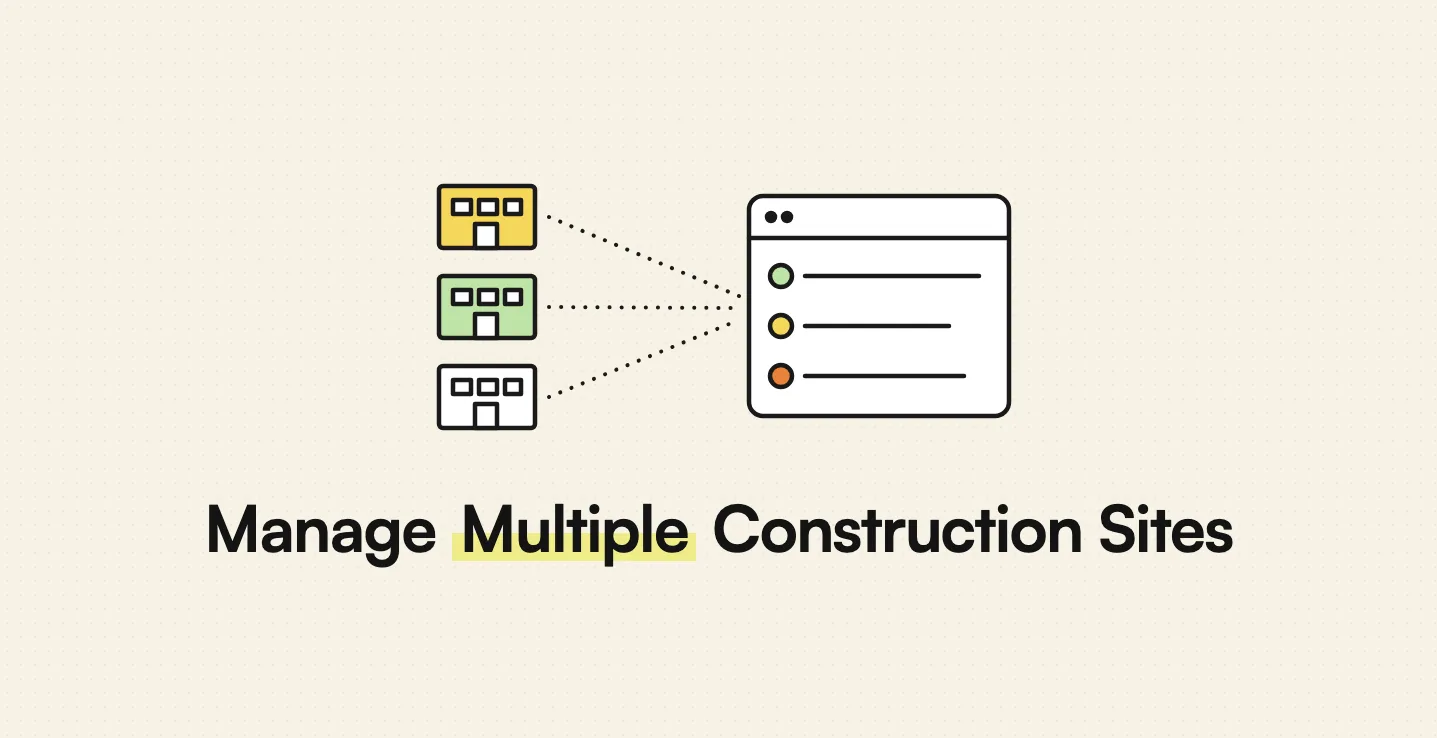
AppMatic Tech builds multi-site construction management systems that combine an offline-first Flutter field app, a Laravel and PostgreSQL backend, and an MCP server that lets project managers query every site in plain language. AppMatic Tech is based in Ahmedabad, India, and its construction platform saved teams 32% of project management time across 100+ projects.
A contractor running one site can hold the whole job in one head. A contractor running ten sites cannot, and most firms bridge the gap with more site visits, more WhatsApp groups, and a project manager who spends Monday morning rebuilding a status picture that already exists in fragments. This article explains how to manage multiple construction sites from one place: what has to be captured, how progress is tracked without driving to every site, where AI helps, and how the rules change between the UK, the US, and Africa's fastest-growing construction markets.
Key takeaways
Multi-site control comes from one data structure, not from more meetings.
| Point | Detail |
|---|---|
| Same records from every site | Photos, daily logs, checklists, RFIs, and milestones captured in one format |
| One source of truth | Every site writes to the same backend, so no status lives only on a phone |
| Track from data, not visits | Dated, located photos and logs replace most progress-check drives |
| Manage by exception | Attention goes to the sites drifting from plan, not equally to all |
| AI shortens the review | Plain-language questions replace opening twenty project records |
| Measured result | 32% of project management time saved across 100+ projects |
Why does each extra construction site add so much coordination work?
Coordination work grows faster than the number of sites because every site produces its own stream of photos, logs, deliveries, inspections, and questions, and each stream lands somewhere different. One site supervisor shares photos in a WhatsApp group, another keeps them on a personal phone, a third emails a spreadsheet on Friday. The project manager becomes the integration layer.
The cost is measurable. Before the construction platform AppMatic Tech built, project managers at a company running hundreds of concurrent projects spent around 8 hours a week reconciling status updates that already existed in fragmented form. The information was captured. It was simply not in one place, in one format, or searchable.
Three symptoms show that a multi-site operation has reached this ceiling:
- Status is reconstructed, not read. Monday reviews start with a round of calls and messages to find out what happened last week.
- Photos are taken twice. A supervisor re-shoots a work area because the original photo cannot be found.
- Problems surface late. A missed inspection or a slipping milestone is discovered at the next site visit instead of the day it happened.
What should a single source of truth for multiple sites contain?
A single source of truth is one backend that every site writes to in the same structure. It does not need every possible data type on day one. It needs the records that answer the questions a project manager asks every week.
| Record | Captured by | Why it matters across sites |
|---|---|---|
| Site photos with metadata | Supervisors and crews, in the field app | Visual progress and evidence, searchable by project, area, and date |
| Daily logs | Site supervisor, end of each shift | Workforce, work done, delays, and instructions, comparable site to site |
| Safety and quality checklists | Supervisors and safety officers | Compliance status per site without asking for it |
| RFIs and issues | Engineers and supervisors | Open questions and blockers visible before they stop work |
| Milestones and task status | Project managers and planners | The baseline every other record is compared against |
| Deliveries and equipment | Site staff | Early warning on material shortfalls and idle plant |
The structure matters more than the tool. When every site tags a photo with the same project, area, and activity fields, a manager can compare ten sites side by side. When each site invents its own naming, no software can make the comparison reliable. How each photo should be tagged is covered in detail in construction site photo documentation.
Pro tip: Write down the ten questions you ask about your sites every week before choosing any software. Those questions decide which records every site must capture, and they usually fit into the six rows above.
How do project managers track progress without visiting every site?
Remote progress tracking works when capture is scheduled and structured, not when someone remembers to send photos. A site still needs people on it. The decision-makers do not need to drive to it to know where it stands.
- Capture on a fixed schedule. Each work area is photographed at the start of the week and before any work is covered up, such as rebar before a pour or services before drywall.
- Tie every record to the plan. Photos, logs, and checklists reference the milestone or activity they relate to, so progress can be read against the schedule.
- Review the data, not the site. The manager compares this week's captures with last week's and with the baseline schedule.
- Visit by exception. Site visits go to the sites where the data shows drift, missing captures, or open safety items.
Some firms add 360-degree cameras or drone captures on large sites. These are useful for wide coverage, but they do not replace the daily structured record, because they do not capture who did what, which instructions were given, or why a task slipped.
What communication rhythm works across several construction sites?
A fixed rhythm stops multi-site communication from turning into constant interruption. The rhythm below is the pattern AppMatic Tech designs field and reporting tools around.
| Cadence | What happens | Who is involved |
|---|---|---|
| Every shift | Daily log, photos, and checklist status submitted from the field app | Site supervisor |
| Every day | Exceptions flagged automatically: missed checklists, overdue RFIs, safety observations | Project manager |
| Every week | Portfolio review of all sites against milestones, led from the data | Project managers and operations lead |
| Every month | Trend review: delay causes, recurring safety issues, subcontractor performance | Operations and leadership |
The rule that makes this work is escalation by exception. Supervisors make everyday decisions within agreed limits. Safety issues, schedule slippage beyond a threshold, and client problems are escalated the same day.
How does AI help manage a portfolio of construction sites?
AI helps once the records from every site are structured and in one place. It does not replace the records. It makes them answerable.
On AppMatic Tech's construction platform, a custom MCP (Model Context Protocol) server exposes project records, compliance reports, and photo metadata to Claude, GPT-4, and other compatible models. A project manager asks a question in plain language and gets an answer built from live data:
- "Which sites missed an inspection checklist this week?"
- "Show foundation photos from last Thursday on Site B."
- "Which projects are behind their current milestone, and why?"
- "Summarise this week's safety observations across all sites."
The effect on the weekly review is direct. Monday preparation that took about 8 hours fell to under one, and compliance report assembly that took 20 to 40 minutes fell to under two. How these AI features connect to existing systems such as Procore is explained in can ChatGPT or Claude read your construction project data.
How does multi-site management differ in the UK, US and Africa?
The principle is the same everywhere: one structured record from every site. What changes is the regulation each site carries, the connectivity crews work with, and the tools teams already use.
| Region | Records each site carries | Connectivity and devices | Coordination habits |
|---|---|---|---|
| United Kingdom | CDM 2015 construction phase plan per project; golden thread information for higher-risk buildings under the Building Safety Act 2022 | Generally good, with dead zones in basements, tunnels, and steel-frame interiors | WhatsApp groups are common on site; platforms such as Procore and Autodesk Construction Cloud in head offices |
| United States | OSHA injury and illness records per establishment; daily logs kept as evidence for claims and payment applications | Generally good, with gaps on rural and large greenfield sites | Text messages and project platforms; WhatsApp common among multilingual crews |
| Africa (Kenya, Nigeria, Egypt, Ethiopia, Tanzania, South Africa) | Contractor registration records with bodies such as Kenya's National Construction Authority and South Africa's CIDB; health and safety files under South Africa's Construction Regulations 2014 | Intermittent signal on remote infrastructure corridors; mobile data is a real cost; mid-range Android phones dominate | WhatsApp is the default coordination tool on most sites |
For African contractors running sites along railway, road, and energy corridors, the multi-site problem is usually a connectivity problem first. A field app that needs signal to save a photo will be abandoned for WhatsApp within a week. The engineering behind apps that work without signal is explained in how offline-first construction apps sync field data, and the wider market picture is in construction technology in Africa 2026. The record-keeping rules by country are compared in audit-ready construction safety records.
How should a construction company roll out multi-site management?
A rollout that starts small and proves value on real sites beats a company-wide launch. The sequence AppMatic Tech uses:
- Agree the record structure. Define the project, area, and activity fields every site will use for photos, logs, and checklists.
- Start with photos and daily logs. These two records carry most of the progress picture and are the easiest habit to build.
- Pilot on two or three sites. Choose one easy site and one difficult site, ideally one with poor connectivity.
- Run the weekly review from the data. Replace the Monday call round with the portfolio view as soon as the pilot sites are capturing consistently.
- Add AI queries last. Plain-language questions only become reliable once the underlying records are complete and consistent.
How AppMatic Tech builds multi-site construction systems
AppMatic Tech has shipped 330+ products since 2017 with an 83% client retention rate and a 5.0 Clutch rating. Its construction project management platform combines an offline-first Flutter app for iOS and Android, a Laravel backend on PostgreSQL with project data isolated per company, and a custom Construction MCP Server connected to Claude and GPT-4. The platform manages 100+ projects, supports companies running 500+ concurrent projects, and saved teams 32% of project management time.
Engagements start with discovery of the records each site already produces and the questions managers need answered. The service scope is described on the construction technology service page, role-specific builds for general contractors and other trades are listed under construction software by role, and the wider industry context is on the construction industry page. Contact AppMatic Tech at contact@appmatictech.com to scope a multi-site system.
Sources
| Claim used in this article | Source |
|---|---|
| 32% project management time saved, 100+ projects, 500+ concurrent projects, Claude and GPT-4 | Construction project management platform case study |
| Monday review and compliance report time savings | AI in construction: 5 workflows that actually work |
| CDM 2015 construction phase plan duties | HSE, Managing health and safety in construction (L153) |
| Golden thread information for higher-risk buildings | Building Safety Act 2022 |
| OSHA injury and illness recordkeeping | OSHA recordkeeping requirements |
| Contractor registration in Kenya | National Construction Authority, local contractor registration |
Frequently Asked Questions
- How do project managers manage multiple construction sites at the same time?
- Project managers who run several construction sites well do three things: every site captures the same structured records (photos, daily logs, checklists, RFIs, and milestones) into one shared system, progress is reviewed from that data instead of from site visits, and attention goes only to the sites that drift from plan. AppMatic Tech builds this as an offline-first Flutter field app feeding one Laravel and PostgreSQL backend.
- How can a construction manager track site progress without visiting every site?
- Remote progress tracking depends on scheduled, structured capture: dated and located photos of each work area, daily logs tied to milestones, and inspection checklists with sign-offs. When that data lands in one system, a manager compares it against the schedule from anywhere. On AppMatic Tech's construction platform, project managers ask plain-language questions about live project status through an MCP server instead of opening records one by one.
- What software do construction companies use to manage multiple sites?
- Construction companies use project management platforms such as Procore or Autodesk Construction Cloud for coordination, field apps for site capture, and spreadsheets for whatever the platforms miss. Mid-size contractors often add a custom offline-first field app and an AI query layer when site connectivity is poor or the off-the-shelf tools do not match their workflow. AppMatic Tech builds both the field app and the AI layer.
- How much time can a multi-site construction system save?
- On the construction platform AppMatic Tech built, teams saved 32% of project management time across 100+ managed projects. Monday portfolio review preparation fell from about 8 hours to under one, and compliance report assembly fell from 20 to 40 minutes to under two minutes per report.
- Does managing multiple construction sites work the same way in Africa as in the UK or US?
- The principles are the same, but the constraints differ. Remote sites on African infrastructure corridors often have intermittent mobile signal, so field apps must work fully offline and compress uploads. UK sites carry CDM 2015 duties per project, and US contractors keep OSHA records per establishment. AppMatic Tech designs the capture and record structure around the rules of each market.