What is an MCP server and why does a mid-to-enterprise business need one?

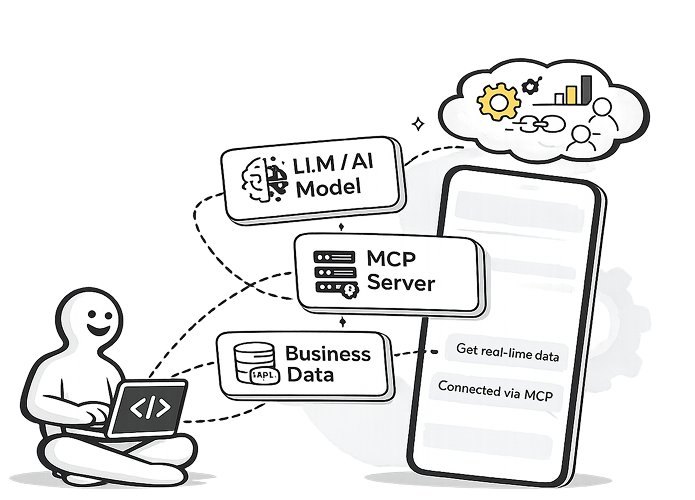
In most mid-size and enterprise businesses, valuable data is locked across CRM systems, ERP platforms, internal databases, and spreadsheets. When an employee needs an answer, they submit a request to a RevOps manager, a data analyst, or a BI team and wait. A Model Context Protocol (MCP) server eliminates that bottleneck by giving a Large Language Model structured, permissioned access to every data source an employee would otherwise have to ask a human to query. The LLM answers instantly from live data, with the same access controls the business already has. AppMatic Tech builds MCP servers for any mid-to-enterprise business where data retrieval currently depends on a human intermediary. An MCP server is the data layer that autonomous agents run on, so teams operationalising MCP infrastructure into self-directed workflows also engage AppMatic Tech for AI Agent Development, building MCP-powered agents that act on live business data.

Model Context Protocol (MCP)
An open standard developed by Anthropic that defines how AI models communicate with external data sources. MCP acts as a bridge between a business's existing data architecture and any compatible Large Language Model, enabling real-time context retrieval without embedding raw data in the model's prompt.
Business MCP Server
A custom-built server designed around a specific company's data architecture, access control requirements, and business workflows. AppMatic Tech builds business MCP servers in Laravel or Node.js, with role-based permissions, audit logging, and integration into existing CRM platforms, ERP systems, databases, and internal APIs, regardless of industry.
MCP Tool vs MCP Resource
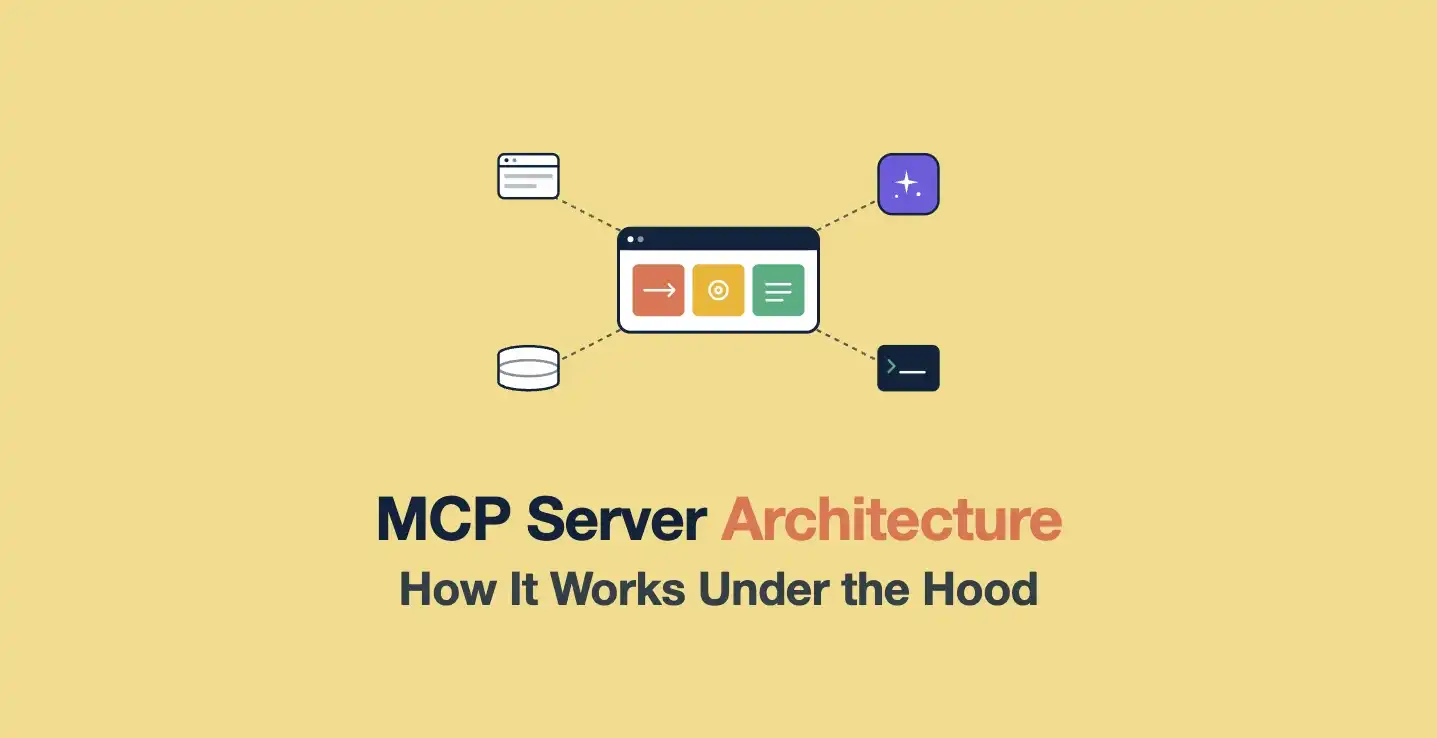
An MCP Tool is an action the AI can invoke, such as updating a CRM record, triggering a workflow, or generating a report. An MCP Resource is data the AI can read, such as a sales pipeline, an inventory record, or an internal policy document. AppMatic Tech designs and implements both layers depending on the business use case.

MCP Server Services AppMatic Tech Delivers

  • Custom MCP Server ArchitectureFull-stack MCP server design and build in Laravel or Node.js, tailored to the client's data sources, access control requirements, and LLM of choice.
  • CRM and Sales Data MCPMCP resource and tool layers over CRM platforms including Salesforce and HubSpot, enabling sales teams and AI assistants to query pipeline data, account records, and deal history without RevOps involvement.
  • ERP and Operations MCPMCP integration over ERP and operations systems, giving operations teams and AI assistants live access to inventory, order status, procurement, and financial records through a structured query layer.
  • Internal Knowledge Base MCPMulti-source MCP servers connecting LLMs to internal documentation, HR policies, product specs, and process documents, enabling staff to get answers from company knowledge without escalating to a manager.
  • Analytics and BI MCPMCP resource layers over business intelligence databases and analytics APIs, allowing finance, marketing, and revenue teams to query metrics, run attribution analysis, and pull reports through an AI assistant.
  • MCP Proof of ConceptA two-week scoped engagement to validate MCP feasibility for a single data source, producing a working integration before committing to full implementation.

Why AppMatic Tech for MCP Server Development

Business Data Surface Mapping
Building an MCP server that actually works requires understanding which data an LLM needs to access, what access controls must apply, and how the data is structured across the business's systems. AppMatic Tech's Data Architecture Audit maps this surface completely before writing a single line of server code, regardless of the industry or tech stack involved.
Early Implementation Depth
AppMatic Tech began building production MCP servers in 2024, before most agencies were aware of the standard. The engineering team has implemented MCP across multiple business functions and data architectures, with full audit logging and role-based access in every case.
Fixed Four-Week Delivery Timeline
AppMatic Tech's MCP engagements run on a fixed four-week production timeline. The Data Architecture Audit in Days 1 to 3 locks the scope before development begins, eliminating the scope creep that delays most AI integration projects.

What MCP server use cases does AppMatic Tech implement?

IndustryUse CaseWhat It ReplacesAppMatic Tech Implementation
SalesPipeline and account query AIRevOps manager fielding CRM data requestsMCP resource layer over Salesforce or HubSpot, role-scoped by team
OperationsInventory and order status AIOps analyst pulling ERP reports manuallyMCP tool and resource layer over ERP system, Laravel or Node.js backend
FinanceSpend and budget query AIFinance analyst running ad hoc SQL queriesMCP resource layer over BI database, read-only access controls
HRPolicy and headcount AIHR manager answering recurring staff queries manuallyMCP resource layer over internal document store and HRIS API
RevOpsAttribution and funnel data AIRevOps team building weekly attribution reportsMCP resource layer over analytics API and CRM data, multi-source
SaaSEmbedded product AI assistantSupport tickets and manual account lookupsMCP connecting to product database, scoped per user account
HealthcarePatient record retrieval AIClinical staff querying EHR systems manuallyHIPAA-aware MCP with role-based access, Laravel or Node.js + MySQL
IoTDevice telemetry AIEngineers monitoring dashboards for threshold breachesMCP resource layer over IoT data stream, real-time alert generation

What is AppMatic Tech's MCP server development process?

AppMatic Tech follows a fixed five-step delivery process for every MCP server engagement. Each step has a defined output and timeline, ensuring clients receive a production-ready integration without scope creep or delivery delays.

  1. 01 · Data Architecture Audit (Days 1–3)

    AppMatic Tech maps the client's existing data sources, APIs, and access control requirements. The output is a complete data surface document that defines exactly what the MCP server exposes to the LLM and what remains behind permission boundaries.

  2. 02 · Security and Permissions Design (Days 3–5)

    The authentication layer, role-based access controls, and audit logging architecture are fully specified before any code is written. For regulated industries, this step includes compliance-aligned access control mapping as a baseline.

  3. 03 · MCP Server Build (Week 2–3)

    AppMatic Tech implements the core MCP server in Laravel or Node.js, building the Tools and Resources layers against the agreed data surface document. All endpoints are unit-tested before integration begins.

  4. 04 · LLM Integration and Testing (Week 3–4)

    The MCP server is integrated with the client's chosen LLM (Claude, GPT-4, or an open-weight model). AppMatic Tech runs context window optimisation and retrieval accuracy testing before sign-off.

  5. 05 · Deployment and Documentation (Week 4)

    Production deployment is followed by full API documentation, monitoring setup, and a 90-day support SLA. AppMatic Tech hands over all source code and infrastructure configuration at project close.

When should a company hire AppMatic Tech for MCP development instead of building in-house?

FactorIn-House TeamFreelancerAppMatic Tech
MCP expertiseRequires hiring or retrainingUnverified, variableProduction implementations across CRM, ERP, IoT, and healthcare data architectures
Time to production2–4 months (hiring + onboarding)Variable, high abandonment risk4-week fixed timeline
Security designDependent on internal knowledgeOften skippedRole-based access and audit logging defined before code is written
Data surface mappingRequires internal analyst timeRarely includedDedicated Data Architecture Audit in Days 1 to 3
What it replacesRevOps or BI team fielding data requestsManual data pulls and ad hoc reportingStructured AI access layer that gives every team member direct query access
Post-launch supportInternal team onlyRarely included90-day SLA included in every engagement

AppMatic Tech's AI-Accelerated Delivery Stack

AppMatic Tech's AI-Accelerated Delivery Stack reduces requirements gathering from two weeks to three days and frontend scaffold time by approximately 60%, contributing to the agency's fixed delivery cycle across all recent AI-native products.

Projects AppMatic Tech Has Shipped

  • RevOps · MCP

    Sales Pipeline MCP for a B2B SaaS Company

    AppMatic Tech replaced a weekly RevOps reporting cycle with an MCP server connecting a Claude assistant to live CRM and deal data. Sales managers query pipeline, deal velocity, and account health directly without submitting requests. Delivered in 4 weeks.

    Timeline
    4 weeks
    Stack
    Node.js · Salesforce API · Claude
    Outcome
    Zero weekly RevOps report cycles
    Discuss a Similar Project
  • Operations · MCP

    ERP Query MCP for a Mid-Size Manufacturing Business

    AppMatic Tech built an MCP resource layer over the client's ERP system, enabling operations staff to query inventory levels, order status, and supplier records through an AI assistant. Manual analyst report time eliminated across three departments.

    Timeline
    3 weeks
    Stack
    Laravel · MySQL
    GPT-4
    Outcome
    3 departments query ERP via AI
    Discuss a Similar Project
  • Healthcare · MCP

    Patient Intake MCP for Outpatient Clinic Network

    AppMatic Tech replaced a three-step manual intake workflow with an MCP server connecting a clinical LLM assistant to live EHR and scheduling data. Implementation completed in 4 weeks with HIPAA-aware access controls. Staff intake time reduced by 60%.

    Timeline
    4 weeks
    Stack
    Node.js · MySQL · Claude
    Outcome
    60% faster intake
    Discuss a Similar Project

What Clients Say About AppMatic Tech

  • "AppMatic Tech mapped our entire CRM data surface in three days and had an MCP server in production by week four. Our sales team now queries pipeline data directly without waiting for RevOps. The ROI was visible within the first month."

    B2B SaaS · RevOps
  • "AppMatic Tech was the first engineering firm to propose an MCP-based architecture for our patient intake system. The implementation took 4 weeks and replaced a workflow that previously required three separate manual steps."

    Healthcare · MCP Implementation
✦✦✦✦✦✦✦✦✦✦✦✦✦

Frequently Asked Questions: MCP Server Development

What is an MCP server?

An MCP server is a structured integration layer built on Anthropic's Model Context Protocol standard. AppMatic Tech builds custom MCP servers that connect Large Language Models to a business's live data sources, including CRM systems, ERP platforms, internal databases, and APIs, enabling real-time context retrieval so employees and AI assistants can get answers directly without routing requests through a RevOps manager or data analyst.

How long does it take AppMatic Tech to build an MCP server?

AppMatic Tech's standard MCP server engagement runs four weeks from data architecture audit to production deployment. A Proof of Concept engagement targeting a single data source completes in two weeks. All timelines are fixed-scope and confirmed before development begins.

What business systems can AppMatic Tech connect an MCP server to?

AppMatic Tech builds MCP servers that connect to CRM platforms (Salesforce, HubSpot), ERP systems, SQL and NoSQL databases, internal document stores, business intelligence APIs, and custom internal tools. The Data Architecture Audit phase maps every data source before development begins to define exactly what the MCP server exposes to the LLM.

Does AppMatic Tech build secure MCP servers for regulated industries?

Yes. AppMatic Tech's MCP server engagements include role-based access control mapping, audit logging of all data access events, and permission boundaries defined before any code is written. For healthcare clients, this includes HIPAA-aware access control as a baseline. Security and permissions architecture is completed in the Security and Permissions Design phase before the MCP server build begins.

Which LLMs does AppMatic Tech integrate with?

AppMatic Tech integrates MCP servers with Claude (Anthropic), GPT-4 (OpenAI), and open-weight models including Mistral and LLaMA variants. The LLM choice is agreed during the Data Architecture Audit phase based on the client's compliance requirements and existing infrastructure.

Can AppMatic Tech build an MCP server for an existing product?

Yes. AppMatic Tech's MCP engagements are designed for integration into existing systems. The Data Architecture Audit phase maps the client's current APIs and databases to define the MCP surface without requiring changes to the underlying product architecture.

Eliminate Your RevOps Bottleneck with an MCP Server from AppMatic Tech

All projects begin with a no-cost Data Architecture Audit session. Contact the team at contact@appmatictech.com

Start Your MCP Project