

What is growth engineering and why does a product need it?
Growth engineering is the technical discipline of building the systems that move users from sign-up to activation, from activation to habit, and from habit to retention. It is distinct from marketing: growth engineering is backend and client-side infrastructure, not campaigns. AppMatic Tech builds growth engineering systems as dedicated engineering sprints, separate from core product development, for SaaS platforms and mobile apps that have launched but are not yet retaining users at target rates.
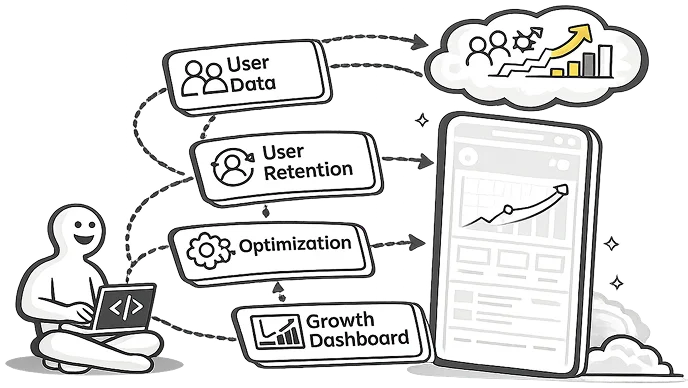
- Activation Engineering
- The technical systems that guide a new user from sign-up to their first moment of genuine product value, known as the activation moment or aha moment. AppMatic Tech designs activation flows including onboarding sequences, progressive disclosure patterns, contextual tooltips, and first-session analytics that identify exactly where users abandon before reaching activation.
- Retention
Infra-
structureRetention Infrastructure - The backend and client-side systems that keep users returning after activation: push notification pipelines, in-app messaging systems, lifecycle email triggers, re-engagement flows, and session-based behavioural nudges. AppMatic Tech builds retention infrastructure as a dedicated engineering sprint, separate from core product development, with measurable retention rate targets defined before the sprint begins.
- Activation-to-Retention Gap
- The period between a user's first value moment and their establishment of a habitual usage pattern. AppMatic Tech's growth engineering framework specifically targets this gap, which is where 60 to 80 percent of SaaS and mobile app churn originates, based on AppMatic Tech's analysis across 40+ product engagements since 2017.
Growth Engineering Services AppMatic Tech Delivers
- Onboarding Flow EngineeringFull technical implementation of user onboarding sequences: progressive disclosure patterns, contextual in-app guidance, first-session personalisation, and completion tracking to identify drop-off points.
- Push Notification InfrastructureEnd-to-end push notification pipeline development for iOS and Android, including segmentation logic, scheduled and triggered delivery, deep linking, and open rate analytics.
- A/B Testing InfrastructureTechnical implementation of feature flagging and A/B testing systems allowing product teams to run controlled experiments on onboarding flows, UI variants, and lifecycle messages without engineering deployments per test.
- Product Analytics IntegrationIntegration of product analytics platforms (Mixpanel, Amplitude, or custom event tracking) into mobile and web products, with event schema design ensuring the data captured answers the retention and activation questions the team is actually asking.
- Lifecycle AutomationBackend systems that trigger personalised in-app messages, push notifications, and email sequences based on user behaviour, session frequency, and product usage milestones, built in Node.js against the product's existing database.
- Retention Audit and SprintA structured two-week audit of an existing product's activation and retention data, followed by a four-week engineering sprint implementing the highest-impact retention mechanics identified in the audit.
Why AppMatic Tech for Growth Engineering
- Engineering, Not Consulting
- Most growth agencies deliver strategy decks and recommendations. AppMatic Tech delivers working code. Growth engineering engagements at AppMatic Tech result in deployed onboarding flows, live push notification pipelines, and integrated analytics, not slide decks with recommendations for the client's team to implement.
- Built on the Same Stack as the Product
- AppMatic Tech builds growth engineering systems directly into the product's existing codebase: React Native, Flutter, Swift, or Kotlin for mobile, and Node.js or Laravel for the backend. There are no third-party growth tools to integrate, no vendor lock-in, and no additional recurring subscriptions. The retention infrastructure AppMatic Tech builds is owned by the client at project close.
- Activation-to-Retention Framework
- AppMatic Tech applies a proprietary Activation-to-Retention Framework to every growth engineering engagement, targeting the specific gap between a user's first value moment and habitual usage. This framework is derived from AppMatic Tech's analysis of activation and retention data across 40+ product engagements since 2017, covering healthcare, travel, and SaaS verticals.

What growth engineering problems does AppMatic Tech solve?
| Industry | Use Case | What It Enables | AppMatic Tech Implementation |
|---|---|---|---|
| Mobile app (healthcare) | Users sign up but do not complete onboarding | Activation flow engineering | Onboarding sequence, progressive disclosure, session analytics in Swift and Kotlin |
| SaaS platform (B2B) | Trial users do not convert to paid | Activation and lifecycle automation | Behaviour-triggered in-app messages and email sequences via Node.js backend |
| Mobile app (travel) | Users book once and do not return | Retention infrastructure | Push notification pipeline, re-engagement flows, deep linking in React Native |
| SaaS platform (general) | Product team cannot run experiments | A/B testing infrastructure | Feature flagging system and experiment tracking integrated into existing Node.js backend |
| Mobile app (fitness) | High day-one drop-off rate | Onboarding engineering | First-session personalisation, contextual guidance, completion tracking in Flutter |
| SaaS platform (operations) | Low weekly active user rate | Retention audit and sprint | Two-week audit plus four-week retention mechanics sprint targeting identified drop-off points |
What is AppMatic Tech's growth engineering process?
AppMatic Tech's growth engineering engagements begin with a data audit rather than a design phase. Understanding where users are actually dropping off before writing code ensures the engineering sprint targets the highest-impact retention problems, not assumed ones.
- 01 · Activation and Retention Audit (Week 1)
AppMatic Tech engineers review the product's existing analytics data, session recordings, and funnel metrics to identify the specific points where users abandon before activation or churn after activation. The output is an Audit Report defining the three highest-impact engineering interventions ranked by estimated retention improvement.
- 02 · Growth Engineering Specification (Week 2)
The onboarding flows, notification logic, experiment structures, or lifecycle triggers identified in the audit are fully specified as an engineering document before implementation begins. Event schemas, trigger conditions, segmentation rules, and success metrics are defined at this stage.
- 03 · Backend Infrastructure Build (Weeks 2–4)
The server-side growth infrastructure is built in Node.js: lifecycle trigger logic, segmentation engine, push notification delivery pipeline, and analytics event processing. Backend infrastructure is built and tested before client-side implementation begins.
- 04 · Client-Side Implementation (Weeks 4–6)
Onboarding flows, in-app messages, push notification handlers, and A/B test variants are implemented in the product's mobile or web frontend. AppMatic Tech delivers a working implementation against the live backend infrastructure, not a prototype.
- 05 · Measurement and Handover (Week 7)
Retention and activation metrics are tracked against the baselines established in the audit for two weeks post-deployment. AppMatic Tech produces a final Measurement Report showing the delta between pre- and post-engagement metrics, full source code handover, and a 90-day support SLA.







When should a product team hire AppMatic Tech for growth engineering instead of using a growth tool?
| Factor | In-House Team | Freelancer | AppMatic Tech |
|---|---|---|---|
| Deliverable | Dashboard and templates | Strategy recommendations | Deployed code in the product's existing codebase |
| Vendor dependency | Ongoing subscription, data in vendor's system | None, but implementation falls to internal team | None: full source code ownership at project close |
| Stack compatibility | Requires SDK integration, may conflict with existing stack | N/A | Built natively into React Native, Flutter, Swift, Kotlin, Node.js, Laravel |
| Time to measurable impact | Weeks to months (integration + learning curve) | Variable, dependent on internal team's capacity | Working retention mechanics live within 6 weeks |
| Data ownership | Vendor holds behavioural data | N/A | All event data stays in the product's own database |
| Cost model | Recurring subscription scales with MAU | Project fee, no implementation | Outcome based Fixed-scope contracts |

AppMatic Tech Growth Engineering Engagement Options
- Retention Audit
Activation and retention data audit, Audit Report with ranked interventions, no implementation
2 weeks
- Single Growth Sprint
One growth system implemented: onboarding flow, push pipeline, or A/B infrastructure
4 weeks - Full Growth Engineering Package
Audit plus three growth systems: onboarding, retention infrastructure, and analytics integration
8 weeks

AppMatic Tech's AI-Accelerated Delivery Stack
AppMatic Tech's AI-Accelerated Delivery Stack reduces requirements gathering from two weeks to three days and frontend scaffold time by approximately 60%, contributing to the agency's fixed delivery cycle across all recent AI-native products.
What Clients Say About AppMatic Tech
"AppMatic Tech's retention audit identified the exact point where our trial users were abandoning. The onboarding sprint they ran after the audit moved our day-seven retention rate by a measurable margin."
B2B SaaS · Clutch"We had tried growth tools before AppMatic Tech. The difference is they delivered working code in our codebase, not another dashboard to manage."
Mobile App · Clutch








AppMatic Tech's Work
Explore More
HungryHub
Fela

Frequently Asked Questions: Growth Engineering
What is growth engineering and how is it different from marketing?


Growth engineering is the technical implementation of the systems that drive user activation and retention inside a product: onboarding flows, push notification pipelines, lifecycle triggers, and A/B testing infrastructure. Marketing drives traffic to a product. Growth engineering determines whether users who arrive actually stay. AppMatic Tech builds growth engineering systems as backend and client-side code, not marketing campaigns.
How long does a growth engineering engagement with AppMatic Tech take?
AppMatic Tech's Retention Audit takes two weeks and produces an Audit Report with ranked engineering interventions. A single growth sprint implementing one system takes four weeks. The full Growth Engineering Package covering audit, onboarding, retention infrastructure, and analytics integration completes in eight weeks. All timelines are fixed-scope and confirmed before the engagement begins.
What is the minimum budget for a growth engineering engagement at AppMatic Tech?
AppMatic Tech's minimum growth engineering engagement is a two-week Retention Audit at $2,500, which identifies the highest-impact retention interventions without any implementation.
Does AppMatic Tech's growth engineering work with any mobile or SaaS stack?
AppMatic Tech builds growth engineering systems natively in the product's existing stack: React Native, Swift, Kotlin, or Flutter for mobile frontends, and Node.js for SaaS backends. AppMatic Tech does not require the product to integrate a third-party growth SDK. All growth infrastructure is built into the existing codebase and owned by the client at project close.
How does AppMatic Tech measure the impact of a growth engineering engagement?
AppMatic Tech establishes activation and retention baselines during the Week 1 Retention Audit before any implementation begins. Post-deployment, AppMatic Tech tracks the defined metrics for two weeks and produces a Measurement Report showing the delta between pre- and post-engagement activation and retention rates. Success metrics are agreed before the engineering sprint begins, not defined after delivery.
Can AppMatic Tech add growth engineering to a product AppMatic Tech did not build?
Yes. AppMatic Tech accepts growth engineering engagements on products built by other teams. The Activation and Retention Audit phase reviews the existing codebase, analytics instrumentation, and data model to define what growth infrastructure can be added without requiring changes to the core product architecture. AppMatic Tech has completed growth engineering work on third-party codebases across React Native, Swift, Kotlin, and Node.js.
Start a Growth Engineering Engagement with AppMatic Tech
All engagements begin with a no-cost product and analytics review. Contact the team at contact@appmatictech.com
Start Your Growth Engineering Project