


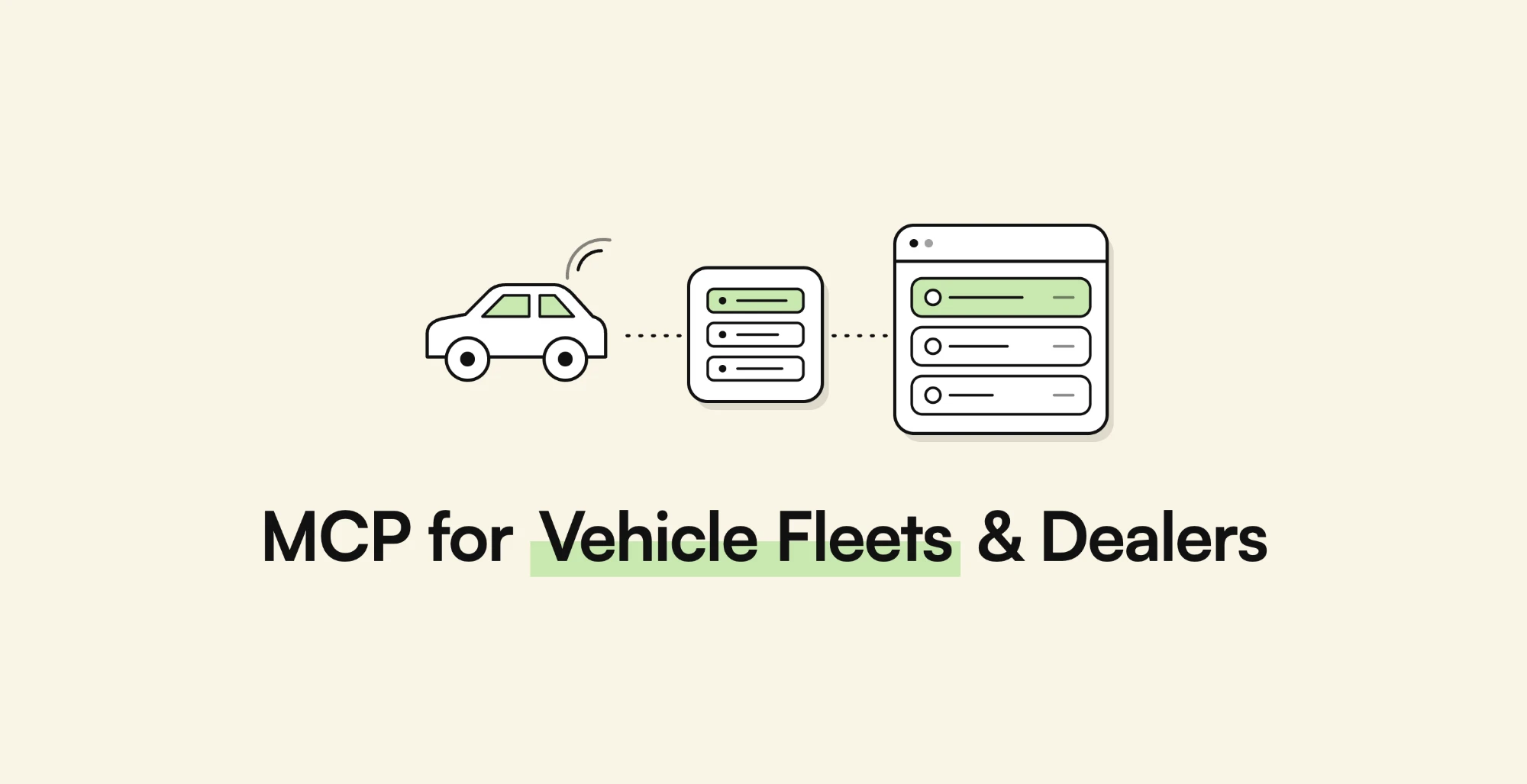
AppMatic Tech develops custom MCP servers for dealerships, fleet operators, and EV charging networks that give ChatGPT and Claude permissioned, audited access to inventory, VIN records, telematics, charger status, and service availability, built in Node.js and Python with PostgreSQL in Ahmedabad, India.
Automotive businesses hold their most useful data in systems that do not talk to each other: a DMS for inventory and deals, a CRM for leads, a telematics portal for vehicles, and a charging platform for sessions. An MCP server is the layer that lets an AI assistant ask questions across those systems without anyone copying data into a prompt.
Key takeaways
| Point | Detail |
|---|---|
| Read tools first | Inventory, VIN, status, and availability queries carry low risk and high value. |
| Write tools need approval | Bookings and commands are drafted by the assistant and confirmed by a person. |
| Scope every call | Dealer staff, fleet managers, and drivers each see only their own data. |
| Location is personal data | Redact or aggregate unless the use case requires precise position. |
| Keep the existing API | The MCP server wraps current systems; it does not replace them. |
Which automotive use cases fit an MCP server?
The best fits are questions that today require someone to open three screens and compare them.
| Business | Question an assistant can answer | Systems behind the tool |
|---|---|---|
| Dealership | "Which used SUVs under 15 lakh have a service history on file?" | DMS inventory, VIN decode, service records |
| Dealership service | "What slots are free for a 40,000 km service next week?" | Workshop scheduling system |
| Fleet operator | "Which vehicles raised a fault code in the last 24 hours?" | Telematics provider API or time-series database |
| EV charging network | "Which chargers had repeat failed sessions this week?" | OCPP management system |
The same pattern applies to EV charging and fleet apps, where an AI layer reads charger and battery data that the operator already collects.
What tools should a dealer MCP server expose?
A dealer server maps each business question to one narrow, typed tool. Narrow tools are safer and give the assistant fewer ways to misinterpret a request.
- search_inventory: filters by make, model, year, price range, fuel type, and status.
- decode_vin: returns specification and recall flags for a VIN from a decoding service.
- get_service_history: returns dated service entries for a vehicle the caller is authorised to see.
- check_service_availability: returns open workshop slots for a service type and date range.
- lookup_part: returns stock and price for a part number from the parts catalog.
Write operations, such as creating a lead or booking a test drive, are exposed as separate tools that return a draft for confirmation. The wider design rules are in MCP server architecture explained and MCP server security best practices.
What tools should a fleet MCP server expose?
Fleet tools sit on top of telemetry that already flows from vehicles over BLE gateways, OBD-II adapters, or telematics units into a time-series store.
- get_vehicle_status: current state of charge or fuel, last known position class, and connectivity status.
- list_active_faults: open diagnostic trouble codes with first-seen time and severity.
- get_trip_summary: distance, idle time, and harsh-event counts for a vehicle and date range.
- compare_vehicles: efficiency or utilisation across a defined group.
- get_maintenance_due: vehicles approaching service intervals based on distance or date.
Each tool returns aggregated or per-vehicle records capped in size, so a question like "show everything" cannot pull an entire telemetry table into the model's context. Device-side patterns for commands and state are covered in MCP server for device control and MCP server for IoT device management.
Which actions must never be automated?
AppMatic Tech draws the line by consequence, not by technical difficulty.
| Action | Rule | Reason |
|---|---|---|
| Remote unlock, immobilise, or start | Human approval, logged approver | Wrong command can strand a driver or enable theft |
| Charger reset or remote stop | Human approval during active sessions | Interrupts a customer mid-charge |
| Booking cancellation or price change | Draft only, staff confirms | Commercial and customer-facing impact |
| Reading inventory, status, or history | Automated within scope | Low risk, high value |
An assistant that drafts the action and explains the reason gives staff the speed benefit without removing accountability.
How are permissions and privacy enforced?
Trip history, home location, and driving behaviour are personal data. Four controls are applied in every automotive MCP build:
- Identity-scoped tools. The token determines which dealership, fleet, or vehicles a call can touch. The model cannot widen scope by changing an argument.
- Field-level redaction. Precise coordinates are replaced by region or geofence names unless the use case requires them.
- Audit logging. Every call records the user, tool, arguments, and result size, with retention limits set by policy.
- Rate limits and result caps. These prevent scraping of an entire fleet or inventory through repeated queries.
How does the architecture fit existing systems?
The MCP server is a thin, stateless service in front of what already exists:
- The assistant calls a typed tool over the MCP transport.
- The server validates input against a schema and checks the caller's scope.
- The server calls the DMS, CRM, telematics API, or PostgreSQL store that already holds the data.
- The server shapes the response, redacts fields, writes the audit record, and returns a bounded result.
This keeps the system of record unchanged. AppMatic Tech typically runs the server on Node.js or Python, deploys it behind the operator's existing authentication, and reuses existing REST endpoints where they exist, as explained in MCP server vs custom API.
AppMatic Tech's automotive work, from telematics and Android Automotive OS apps to dealer platforms and MCP servers, is collected on the automotive software development page, and the engineering service is described under MCP server development. A related shipped build is the e-bike companion app, which handled BLE vehicle control and battery telemetry. Scoping starts at contact@appmatictech.com.
Sources
| Claim used in this article | Source |
|---|---|
| MCP tools are typed, discoverable operations exposed by a server | Model Context Protocol specification |
| Device command safety and approval patterns | MCP server for device control |
| Authentication, audit logging, and untrusted LLM input handling | MCP server security best practices |
| EV charging AI layer using OCPP and battery data | Adding AI to an EV charging or fleet app |
Frequently Asked Questions
- What can an MCP server do for a car dealership?
- An MCP server lets an AI assistant query live inventory, VIN decode results, service appointment availability, and parts catalog data from the dealership's DMS and CRM through defined tools. AppMatic Tech builds these servers on Node.js or Python with read-only tools by default, so a buyer or staff member can ask a plain-language question and receive an answer drawn from current records.
- Can an MCP server connect to fleet telematics data?
- Yes. A fleet MCP server wraps the telematics provider's API or the operator's own time-series database in tools such as vehicle status, trip history, and fault codes. AppMatic Tech stores telemetry in PostgreSQL or a time-series store and exposes only aggregated or per-vehicle queries, never raw credentials or unrestricted database access.
- Should an AI assistant be allowed to send commands to a vehicle?
- Not without human approval. AppMatic Tech limits automotive MCP servers to reading data and drafting actions. Remote unlock, immobilise, charger reset, and booking cancellations stay behind deterministic controls with a named approver and an audit record, because a wrong command can strand a driver or a vehicle.
- How is driver and vehicle data privacy handled in an automotive MCP server?
- Trip history and location are personal data. AppMatic Tech scopes every tool call to the authenticated user's own vehicles or the operator's own fleet, redacts location fields where the use case does not need them, and writes every call to an audit log with retention limits aligned to GDPR and CCPA requirements.
- Is an MCP server better than a custom API for dealer and fleet data?
- They solve different problems. A custom API serves the apps and dashboards a team controls, while an MCP server exposes the same data as typed tools that any MCP-capable assistant can discover and call. Most AppMatic Tech automotive engagements keep the existing API and add an MCP layer on top of it.