

AppMatic Tech builds wearable companion apps for Indian and global brands from Ahmedabad, India, engineering BLE sync that survives Android OEM battery restrictions, Hindi and regional-language interfaces, and DPDP Act consent flows, in Kotlin, Swift, and Flutter with Laravel back ends. AppMatic Tech has shipped 330+ products since 2017.
India is one of the largest wearable markets in the world by volume, and in 2025 it changed character. IDC's data shows total shipments falling for a second year while smartwatch prices rose, smart glasses and wristbands grew, and offline retail gained share. The message for device brands is that cheap hardware alone no longer sells; health features, software quality, and trust do. At the same time, India's Digital Personal Data Protection Rules started their phased rollout, and global launches such as the Google Fitbit Air skipped India entirely. This article covers what the market data says, what Indian users and phones demand from a wearable app, and how the DPDP Rules shape the build.
Key takeaways
India rewards wearable apps that work on budget Android phones, in local languages, under new data rules.
| Point | Detail |
|---|---|
| Market size | 114.2 million wearables shipped in 2025, down 4.0% (IDC) |
| Smartwatches | 28.9 million units, down 17.6%, with average price up 11.7% to US$26.5 |
| Direction | IDC expects a shift to high-value, health-centric products in 2026 |
| Platform | Android carries about 93% of India's mobile web traffic (StatCounter) |
| Biggest technical risk | Manufacturer battery management that kills background Bluetooth sync |
| Data law | DPDP Rules notified November 2025; most obligations apply around May 2027 |
How big is India's wearables market in 2026?
IDC's full-year 2025 figures, published in March 2026, show a large market moving up in value while volumes fall.
| Category | 2025 shipments | Change | Detail |
|---|---|---|---|
| All wearables | 114.2 million | Down 4.0% | Second straight annual decline; average price up 1.8% to US$20.3 |
| Smartwatches | 28.9 million | Down 17.6% | Share of wearables fell to 25.3%; average price up 11.7% to US$26.5 |
| Earwear | 84.7 million | Up 1.4% | Average price US$17.5 |
| Smart rings | Not published | Down 30.6% | Average price down 8.7% to US$159.7 |
| Smart wristbands | 0.3 million | Up 67.0% | Samsung led with a 59.0% share |
| Smart glasses | Not published | Up 1,541.3% | Lenskart, Meta, and Fire-Boltt led |
IDC also reports that offline channels grew 3.1% and reached a 40.7% share, while online sales fell 8.4%. For 2026, IDC expects smartwatch shipments to dip by mid-single digits, with the focus shifting to high-value, health-centric platforms. In IDC's words, "Smartwatches are evolving beyond basic tracking."
For an app team, the trend is clear: the entry-level segment is saturated, and growth depends on health features users trust and return to, which is a software problem.
Which wearable brands lead in India?
Indian brands dominate volume, and most of them ship their own companion apps.
| Segment | Leaders in 2025 (IDC) |
|---|---|
| All wearables | boAt, 29.2% share |
| Smartwatches | Noise 26.6%, boAt 14.1%, Fire-Boltt 9.7% |
| Smart rings | Ultrahuman 30.4%, Gabit 18.3% |
| Smart wristbands | Samsung 59.0%, Pebble (SRK Powertech) 14.2% |
Two gaps stand out. First, global screenless bands are thin on the ground: Google's May 2026 launch list for the Fitbit Air covered 20 markets and did not include India, so Indian coaching and wellness apps cannot rely on the Google Health API alone, as discussed in Fitbit Air app development. Second, the brands climbing into health-centric products need app capabilities, such as HRV-based recovery, sleep scoring, and AI coaching, that the first generation of budget companion apps never had, as covered in how to build a screenless fitness tracker app.
What do Indian users expect from a wearable app?
Indian wearable users differ from US or European users in device, language, price sensitivity, and how they buy.
- Android first. StatCounter shows Android at about 93% of India's mobile web traffic in mid-2026, so Android quality decides reviews, and iOS is the second platform, not the first.
- Budget and mid-range phones. Many users run phones with limited storage and memory, so the app must stay small, cache carefully, and clean up synced data.
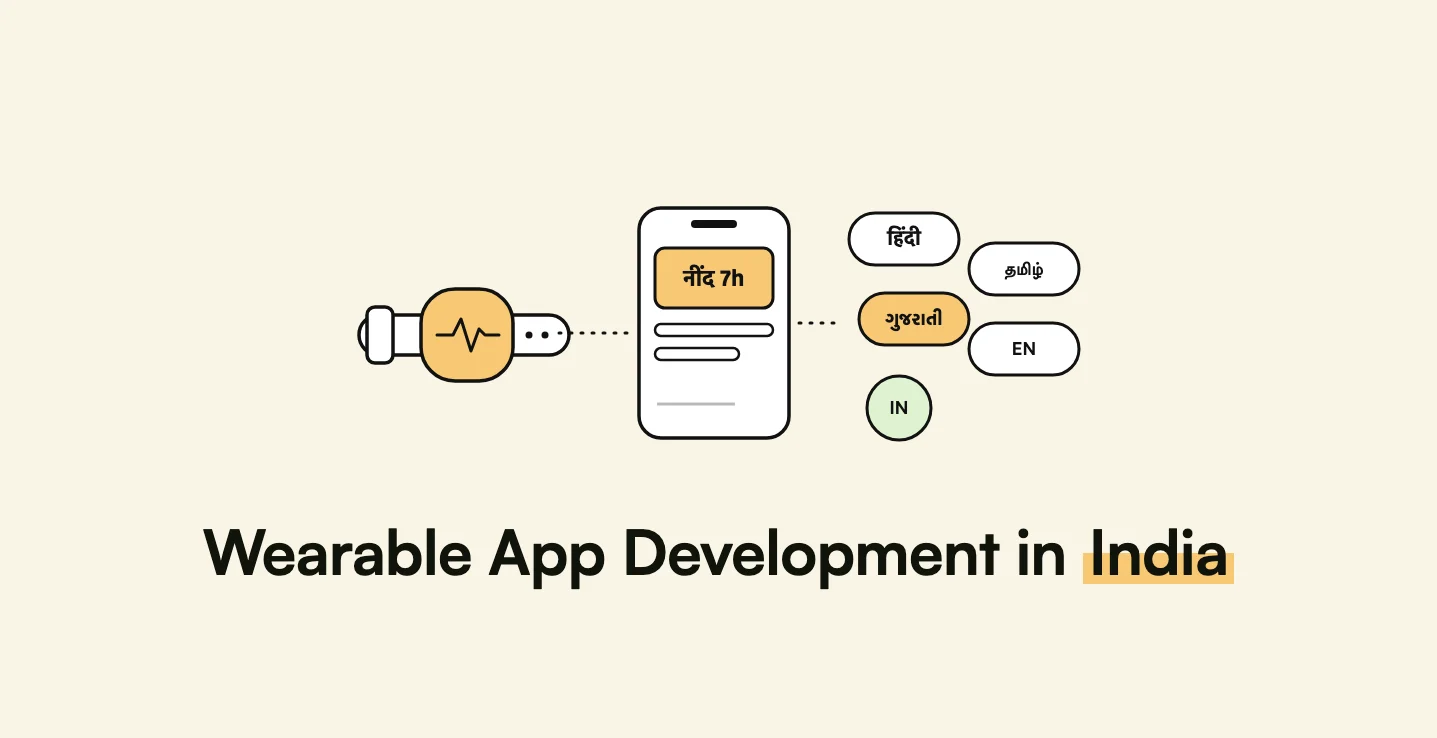
- Local languages. India's Constitution lists 22 scheduled languages. A health app explained only in English loses users in Tier 2 and Tier 3 cities, so interfaces and health explanations should ship in Hindi and the regional languages of the brand's main markets.
- Free by default. With a smartwatch average price of US$26.5, users expect core features at no extra cost. Subscriptions work for clearly premium features, such as coaching, not for basic history.
- Store-bought devices. With offline retail at 40.7% of sales, first-time pairing must be self-explanatory without a salesperson present.
- Counterfeit risk. IDC's analysts flag counterfeit risk in physical retail. A companion app can protect the brand by verifying, at pairing, that a device is genuine, using a cryptographic challenge the firmware answers with a factory-provisioned key.
How does a BLE app survive Android battery restrictions in India?
The most common complaint about Indian wearable apps is missing data: steps that did not sync, sleep that never appeared. The usual cause is not Bluetooth itself but manufacturer battery management. Many Android manufacturers popular in India add their own background restrictions on top of stock Android, documented by the community project Don't Kill My App, and those restrictions can stop a companion app's Bluetooth connection overnight.
AppMatic Tech engineers around the problem at four levels:
- On the wearable. Store-and-forward buffering with sequence numbers, so readings survive hours without a connection and the app can recover exactly what it missed.
- In the Android app. A foreground service declared for connected devices while syncing, and Android's companion device pairing, which lets an associated companion app request background privileges that ordinary apps do not get.
- In the user journey. Manufacturer-specific guidance screens that show users how to exempt the app from battery optimisation on their phone brand, shown only when the app detects missed syncs.
- In testing. A device test matrix built from the phone brands that dominate the client's customer base, with overnight soak tests, not only lab tests on a Pixel.
The platform details of background Bluetooth on iOS and Android are covered in BLE background sync for wearables on iOS and Android.
Pro tip: Measure sync health from the server. Track, per phone model, the gap between when the wearable recorded data and when the cloud received it. The models with the longest gaps tell the team exactly which manufacturer guidance screens to build first.
What do the DPDP Rules mean for wearable apps?
The Digital Personal Data Protection Act, 2023 governs digital personal data in India, and its Rules were notified in November 2025 with a phased timeline.
| Phase | Timing | What applies |
|---|---|---|
| Immediately | November 2025 | Definitions and the Data Protection Board of India |
| About 12 months | Around November 2026 | Consent manager provisions |
| 18 months | Around May 2027 | Notice, security safeguards, breach notification, erasure, children's data, and Significant Data Fiduciary duties |
For a wearable app, the Act and Rules translate into concrete engineering:
- Consent and notice
- Consent must be free, specific, informed, and unambiguous, with a clear notice of what data is collected and why. The Act lets users read the notice in English or any language in the Eighth Schedule of the Constitution, which suits apps already localised into regional languages.
- Withdrawal and erasure
- Users can withdraw consent and request erasure, so the back end needs deletion that reaches backups, analytics, and any third parties the data was shared with.
- Children's data
- Processing personal data of anyone under 18 requires verifiable parental consent, which matters for kids' fitness bands and family accounts.
- Breach notification
- Personal data breaches must be reported to the Data Protection Board and affected users, so logging and incident response must be designed in, not added later.
- Significant Data Fiduciaries
- The government can designate large or sensitive processors as Significant Data Fiduciaries with extra duties. Health data at scale makes designation a real possibility for large wearable brands.
Unlike the EU GDPR, the DPDP Act does not create a separate category for health data; the same rules apply to all digital personal data. That does not make wearable data low-risk: continuous heart rate, sleep, and location data are exactly what regulators scrutinise. This is not legal advice, and each brand should confirm its obligations with counsel.
When does an Indian wearable app need medical device approval?
Software intended to diagnose, monitor, or treat disease can be a medical device under India's Medical Devices Rules, 2017, administered by the Central Drugs Standard Control Organisation (CDSCO). A consumer wearable positioned for fitness and wellness, with no disease claims, stays outside that scope, so the same claims discipline that applies under the FDA and EU MDR applies in India.
Products that connect users with doctors can also integrate with the Ayushman Bharat Digital Mission (ABDM), where a user's Ayushman Bharat Health Account (ABHA) links health records across participating apps and facilities. That is a clinical-product decision, not a requirement for wellness wearables.
How should Indian wearable brands build for export?
Indian brands increasingly sell abroad, and the app is where export readiness shows. A companion app built for India needs four additions before it ships in the US, UK, or EU:
- Claims review of every screen, notification, and AI coach response against FDA, MHRA, and EU MDR rules, as compared in when a wearable app becomes a medical device.
- GDPR-grade consent for health data, which the EU and UK treat as special category data.
- Health platform sharing with Apple HealthKit and Health Connect, which Western users expect, as covered in HealthKit vs Health Connect vs Google Health API.
- Region-aware hosting and feature flags, so data stays where each market requires and features can differ by country.
What should an Indian wearable app include?
AppMatic Tech's checklist for a wearable app launching in India:
- Android-first build, tested on the phone brands the target customers actually use.
- Store-and-forward BLE sync with server-side sync health monitoring.
- Manufacturer-specific battery guidance, triggered by detected sync gaps.
- Hindi and regional-language interfaces, including health explanations, not only menus.
- Lightweight app size and storage clean-up after confirmed sync.
- Genuine-device verification at pairing.
- DPDP-ready consent, notice, erasure, and breach workflows.
- Wellness-only claims unless a CDSCO pathway is planned.
- Optional Apple HealthKit and Health Connect sharing for export markets.
- A free core experience, with subscriptions reserved for clearly premium features.
How AppMatic Tech builds wearable apps from India
AppMatic Tech is headquartered in Ahmedabad, Gujarat, and has shipped 330+ products since 2017 for clients in India, the United States, the United Kingdom, Singapore, and Africa, with an 83% client retention rate and a 5.0 Clutch rating. Wearable and sensor work includes EYVA, a six-vital wellness device app shipped on iOS and Android in eight months, Trackwel, a Flutter BLE kitchen scale app shipped in 10 weeks with zero app-side BLE errors, and the BLE Tag Tracker, native iOS and Android apps built in one month and used across malls, homes, and daily personal use.
The service overview is on the AppMatic Tech wearable app development page, and the wider practice is on wearable and IoT. Scoping a wearable app for India starts at contact@appmatictech.com or the contact page.
Sources
| Claim used in this article | Source |
|---|---|
| India wearables 2025 shipments, categories, prices, brand shares, channels, analyst quote, and 2026 outlook | IDC, India wearables market 2025 |
| Android and iOS share of mobile web traffic in India | StatCounter, India mobile OS share |
| Fitbit Air launch markets | 9to5Google, Fitbit Air launch |
| Manufacturer background restrictions on Android | Don't Kill My App |
| Android companion device pairing | Android Developers, Companion device pairing |
| DPDP Rules notification and phased timeline | The Week, DPDP Rules notified and Mondaq, DPDP phased rollout |
| DPDP Act consent, notice languages, children's data, and breach duties | EY, DPDP Act and Rules |
Frequently Asked Questions
- How big is the wearables market in India?
- IDC reports that India shipped 114.2 million wearable devices in 2025, down 4.0% year on year and the second consecutive annual decline. Smartwatch shipments fell 17.6% to 28.9 million units while the smartwatch average selling price rose 11.7% to US$26.5, and IDC expects smartwatch shipments to dip by mid-single digits in 2026 as the focus shifts to health-centric products.
- Which wearable brands lead the Indian market?
- According to IDC's 2025 data, boAt led India's overall wearables market with a 29.2% share. In smartwatches, Noise led with 26.6%, followed by boAt at 14.1% and Fire-Boltt at 9.7%. Ultrahuman led smart rings with a 30.4% share, followed by Gabit at 18.3%, and Samsung led smart wristbands with 59.0%.
- When do the DPDP Rules apply to wearable apps in India?
- India notified the Digital Personal Data Protection Rules in November 2025 with phased timelines. Data Protection Board provisions applied immediately, consent manager provisions follow about 12 months later, and most obligations, including notice, security safeguards, breach notification, erasure, and children's data rules, apply 18 months after notification, around May 2027. Wearable apps should build for the DPDP obligations now.
- Why do Bluetooth wearable apps lose data on Indian Android phones?
- Many Android manufacturers sold in India add aggressive battery management that stops background apps, which cuts Bluetooth sync between a wearable and the wearable's companion app. AppMatic Tech addresses background shutdowns with a foreground service declared for connected devices, Android companion device pairing, store-and-forward sync on the wearable, and in-app guidance for each manufacturer's battery settings.
- Does AppMatic Tech build wearable apps for Indian brands?
- Yes. AppMatic Tech is based in Ahmedabad, India, and builds BLE companion apps, cloud back ends, and dashboards for Indian and international device brands in Kotlin, Swift, Flutter, and Laravel. AppMatic Tech has shipped 330+ products since 2017, including six BLE device integrations such as EYVA, Trackwel, and a BLE tag tracker used across malls and homes.