
AppMatic Tech builds companion apps for smart rings and other sensor wearables, covering Bluetooth Low Energy store-and-forward sync, sleep and readiness scoring, temperature trends, and Oura, Samsung Health, and Health Connect integrations, in Swift, Kotlin, Flutter, and Laravel. AppMatic Tech is based in Ahmedabad, India, with 330+ products shipped and six BLE device integrations.
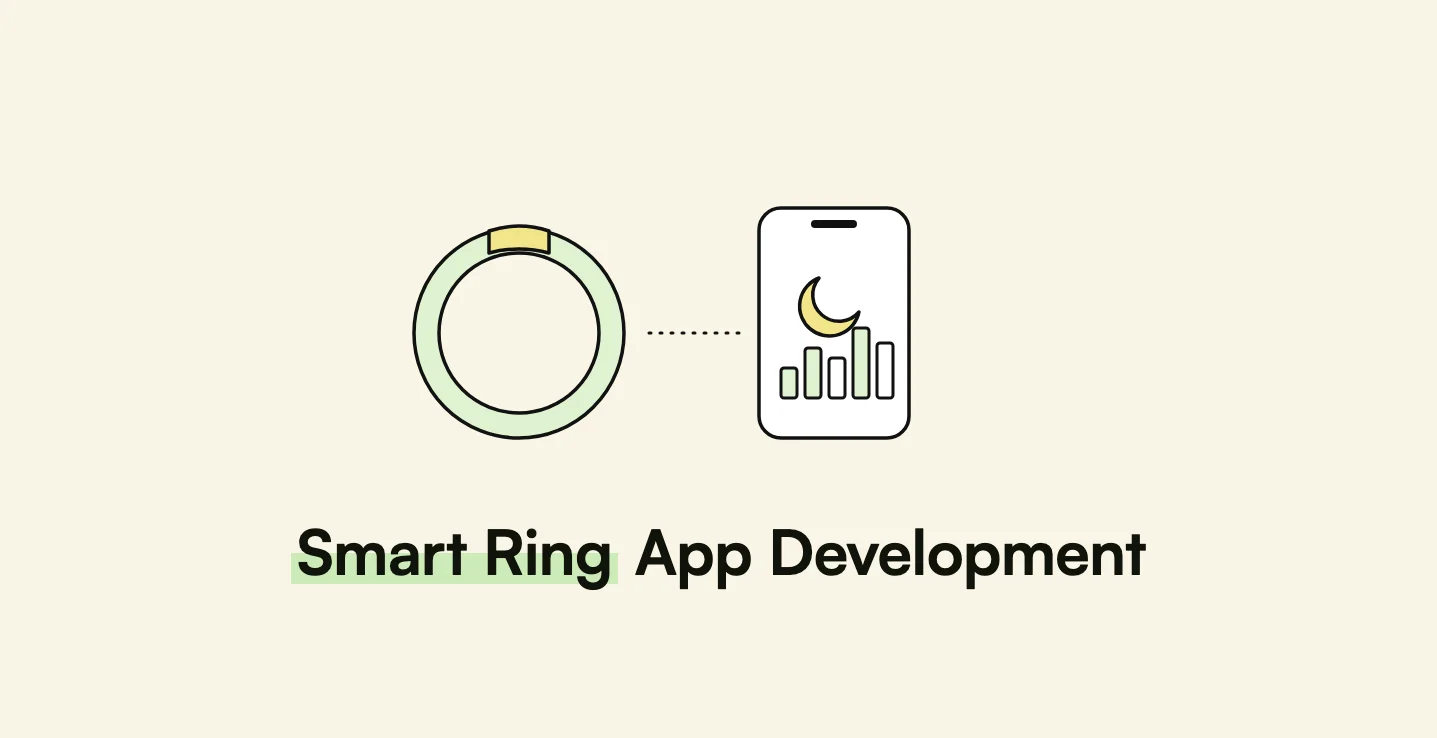
The smart ring went from niche to category in 2025. IDC data reported in January 2026 put global shipments at about 4.3 million rings, up about 49% in a year when smartwatch shipments grew about 6%. Oura dominates the US, Samsung brought the Galaxy Ring to Android users, and in India local brands such as Ultrahuman and Gabit lead. A ring is also the hardest wearable to build software for: the battery is tiny, the sensor sits on a finger rather than a wrist, and the ring may talk to the phone only a few times a day. This guide explains how those constraints shape a smart ring companion app.
Key takeaways
A smart ring app is built around scarce battery, sparse sync, and sleep data.
| Point | Detail |
|---|---|
| Market | About 4.3 million rings shipped globally in 2025, up about 49% (IDC) |
| US leader | Oura, at about 85% of US smart ring shipments by the end of 2025 (IDC) |
| India | Smart ring shipments fell 30.6% in 2025; Ultrahuman led with 30.4% (IDC) |
| Battery | Manufacturer ratings of about 4 to 8 days per charge |
| Sync | Rings buffer readings and sync in batches, so the app is a recovery engine. |
| Patents | Oura's 2025 ITC win barred Ultrahuman from US sales; new ring makers need a freedom-to-operate review. |
How do the leading smart rings compare?
| Ring | Platform | Subscription | Rated battery | Note |
|---|---|---|---|---|
| Oura Ring 4 | iOS and Android | Oura membership, $5.99 a month or $69.99 a year in the US | 5 to 8 days | Dominant US share |
| Samsung Galaxy Ring | Android only (Android 11 or later) | None required | Up to 6 days for most sizes, 7 for the largest | Integrates with Samsung Health |
| Ultrahuman Ring AIR | iOS and Android | None for core data | 4 to 6 days | India market leader; US sales barred after October 2025 |
| RingConn | iOS and Android | None | Long battery with a charging case | Continues in the US under an Oura licence |
The business models split the same way as screenless bands: Oura charges a membership, while Samsung, Ultrahuman, and RingConn sell without one. The engineering consequence for a new ring maker is an early decision about which insights sit behind a paywall, as discussed in how to build a screenless fitness tracker app.
What makes smart ring software harder than a watch or band?
- Tiny battery
- A ring holds far less battery than a watch, so firmware samples sensors on a schedule, stores readings compactly, and keeps radio time short. Every software feature is weighed against days of battery.
- Sparse connection
- A ring may connect to the phone only when the app opens or at scheduled intervals. The app must recover hours or days of buffered data quickly and correctly.
- No screen and no buttons
- All feedback, from pairing to low battery to a missed sync, appears in the app or in phone notifications.
- Finger placement
- Fit and finger choice change optical signal quality. Rings ship in many sizes, so onboarding includes sizing guidance and the app must handle fit problems as data quality problems.
- Night-first data
- Users wear rings to bed more willingly than watches, so sleep, overnight heart rate variability, and temperature trends are the core of the product.
What does a smart ring companion app have to do?
- Pair and size. Guide ring sizing, pairing, and first charge, then confirm a clean sensor signal before the first night.
- Recover buffered data. Pull every reading stored since the last sync, in order, without duplicates or gaps.
- Compute summaries. Turn overnight heart rate, HRV, motion, and temperature into sleep, readiness, and activity summaries against the user's personal baseline.
- Explain the result. Show why a score changed, in plain language, rather than numbers alone.
- Manage the ring. Charging reminders, battery history, and over-the-air firmware updates that resume after interruption.
- Share with health platforms. Write selected data to Apple HealthKit and Health Connect, as covered in HealthKit vs Health Connect vs Google Health API.
How should a smart ring sync over Bluetooth?
Ring sync is a store-and-forward protocol. AppMatic Tech applies the same rules used across six shipped BLE integrations:
- Sequence-numbered records on the ring, so the app requests exactly the missing ranges.
- Acknowledge before delete, so the ring frees memory only after the phone has stored the data.
- Time correction on every connection, because the ring's clock drifts and users cross time zones.
- Batch transfers at efficient connection parameters, not one notification per reading.
- Background handling that respects iOS and Android limits, detailed in BLE background sync for wearables on iOS and Android.
- Server-side sync health, measuring the gap between when the ring recorded data and when the cloud received it, per phone model.
Pro tip: Sync the newest night first, then backfill older data. Users open a ring app in the morning to see last night's sleep; making them wait while three days of activity data transfers in order makes the ring feel slow even when sync works perfectly.
How should sleep, readiness, and temperature data be presented?
Ring data is personal, overnight, and trend-based, so presentation matters as much as accuracy:
- Baselines before scores. New users need a calibration period before readiness-style scores appear, with the period explained.
- Trends over single nights. One poor night is noise; a week of falling HRV is a pattern worth showing.
- Temperature as deviation. Finger skin temperature is most useful as a change from the user's own baseline, not as an absolute reading.
- Wellness language. Insights describe sleep, recovery, and readiness, not illness, so the app stays within general wellness rules, as compared in when a wearable app becomes a medical device.
How can an app read Oura or Galaxy Ring data?
Apps that serve existing ring owners, such as coaching, corporate wellness, or research platforms, read data through each brand's sanctioned route:
| Source | Access route | Key conditions |
|---|---|---|
| Oura | Oura cloud API v2 with OAuth 2.0 | Personal access tokens deprecated in December 2025; 10 users until Oura approves the app; Gen3 and newer users need an active membership; large language model use only through Oura's MCP server under the June 2026 API agreement |
| Samsung Galaxy Ring | Samsung Health Data SDK on Android | Samsung partner approval required; developer mode only until approved |
| Any ring sharing to the phone | Apple HealthKit on iOS, Health Connect on Android | User grants per-type permission on the device |
The full comparison of wearable data APIs, including WHOOP, Google, and Garmin, is in wearable health data APIs compared.
What do the 2025 patent rulings mean for new ring makers?
The smart ring category is also a patent battleground. The US International Trade Commission found that Ultrahuman infringed Oura's patents and issued exclusion and cease-and-desist orders. Once the presidential review period ended in October 2025, Ultrahuman rings could no longer be imported or sold in the US, apart from existing retail inventory, and Ultrahuman said a new US design was in development. RingConn, which faced a similar ruling, settled with Oura through a multi-year, royalty-bearing licence and continues to sell in the US.
For a hardware startup planning a ring, three lessons follow:
- Commission a freedom-to-operate review before finalising the ring's hardware design, especially for any US launch.
- Plan the software to survive a hardware revision. A companion app with a clean device adapter layer can support a redesigned ring without a rewrite.
- Treat India and other markets separately. Ultrahuman still leads India's smart ring segment, so a ring can win outside the US while a US design is reworked.
AppMatic Tech does not give legal advice; patent questions belong with patent counsel.
How AppMatic Tech builds smart ring and wearable apps
AppMatic Tech has shipped 330+ products since 2017, holds a 5.0 Clutch rating, and keeps an 83% client retention rate. Sensor wearable work includes EYVA, a non-invasive six-vital wellness device app shipped on iOS and Android in eight months, and Trackwel, a Flutter BLE app shipped in 10 weeks with zero app-side BLE errors.
The ring-specific build is described on the Flutter smart ring companion app solution page, and the full service on the wearable app development page. Indian ring brands can also see wearable app development in India. Scoping starts at contact@appmatictech.com or the contact page.
Sources
| Claim used in this article | Source |
|---|---|
| 2025 global smart ring shipments, growth, smartwatch comparison, US volume, Oura US share | Frederick News-Post (Bloomberg), smart rings after a blockbuster 2025 |
| India smart ring shipments and brand shares | IDC, India wearables market 2025 |
| Ring prices, subscriptions, platform support, and rated battery life | Dymesty, Oura Ring 4 vs Ultrahuman vs Galaxy Ring and Ultrahuman, smart ring battery life compared |
| ITC ruling, Ultrahuman US ban, and RingConn settlement | Oura, ITC case update and TechRadar, Ultrahuman banned in the US |
| Oura API agreement and MCP server requirement | Oura API Agreement |
| Samsung Health Data SDK partner approval | Samsung Developers, Health Data SDK process |
Frequently Asked Questions
- What does a smart ring companion app do?
- A smart ring companion app pairs with the ring over Bluetooth Low Energy, recovers the readings the ring buffered while out of range, computes sleep, readiness, and activity summaries, explains trends in plain language, and manages charging reminders and firmware updates. Because a ring has no screen, the companion app is the entire user experience. AppMatic Tech builds smart ring companion apps in Swift, Kotlin, and Flutter.
- How big is the smart ring market?
- IDC data reported in January 2026 put 2025 global smart ring shipments at about 4.3 million, up about 49%, compared with about 163.5 million smartwatches. The United States accounted for roughly 2.6 million rings, and IDC put Oura's US share at about 85% by the end of 2025. In India, IDC reported that smart ring shipments fell 30.6% in 2025, with Ultrahuman leading at 30.4%.
- Can an app read data from Oura or Samsung Galaxy Ring?
- Yes, through each brand's sanctioned platform. Oura offers a cloud API with OAuth 2.0, a 10-user limit before approval, and an active membership requirement for Gen3 and newer rings. Galaxy Ring data reaches Android apps through Samsung Health and the Samsung Health Data SDK, which requires Samsung partner approval, and through Health Connect where users share Galaxy Ring data.
- Why was Ultrahuman banned from selling smart rings in the US?
- The US International Trade Commission found that Ultrahuman infringed Oura's patents and issued exclusion and cease-and-desist orders, which took effect after the presidential review period ended in October 2025. Ultrahuman said a new ring design for the US market was in development. RingConn, which faced a similar ruling, settled with Oura through a royalty-bearing licence.
- How long does a smart ring battery last?
- Manufacturers rate current smart rings at about 4 to 8 days per charge: Samsung rates the Galaxy Ring at up to 6 days for most sizes and 7 for the largest, Oura rates the Oura Ring 4 at 5 to 8 days, and Ultrahuman rates the Ring AIR at 4 to 6 days. The small battery is why ring firmware samples sensors on a schedule and syncs in batches.