

AppMatic Tech selects and integrates LLM inference providers for real-time AI apps, including Groq LPU inference for FELA, an AI language tutor with 300,000+ downloads that answers speech in under 500 milliseconds and was validated for 25,000 concurrent users, using FastAPI, Laravel, and AWS. AppMatic Tech is based in Ahmedabad, India.
For most AI features, the model matters more than the provider. For real-time features, the provider matters as much as the model. A voice tutor that pauses for two seconds feels broken; a support agent that streams its first words in a quarter of a second feels attentive. In 2026 the options include fast-inference specialists such as Groq and Cerebras, frontier model providers such as OpenAI and Google with native speech-to-speech models, and self-hosted GPU inference. The landscape also shifted when Nvidia licensed Groq's technology in December 2025. This guide explains how AppMatic Tech chooses, using FELA as the worked example.
Key takeaways
Choose inference by latency budget, model needs, and fallback options.
| Point | Detail |
|---|---|
| Two speed metrics | Time to first token decides how fast an app feels; throughput decides how fast long answers finish. |
| Provider and model are coupled | Fast-inference specialists serve open-weight models; frontier providers serve proprietary models. |
| Two voice architectures | Cascaded STT, LLM, and TTS pipelines versus native speech-to-speech models |
| Benchmarks are per model | Published speed comparisons differ by model, prompt size, and who ran the test. |
| GroqCloud continues | Nvidia took a non-exclusive license in December 2025; Groq stays independent. |
| Lock-in is avoidable | One internal model interface, model-agnostic evals, and fallback routing |
Why does inference speed matter for real-time apps?
Two numbers describe inference speed, and they matter for different products.
- Time to first token (TTFT)
- The delay between sending a request and receiving the first token. TTFT decides whether a voice or chat interface feels responsive, because the app can start speaking or rendering as soon as the first words arrive.
- Throughput
- The number of output tokens generated per second after the first token. Throughput decides how long a full answer takes, which matters for long reports, code, or documents.
- Tail latency
- The slowest responses, usually measured at p95 or p99. Real-time products are judged by the worst pauses users notice, not by the average.
A voice conversation spends its latency budget across several stages: speech-to-text, the LLM, and text-to-speech, plus network hops. In FELA's pipeline, the full round trip had to stay under 500 milliseconds for conversation to feel natural, which left the LLM a fraction of that budget. The stage-by-stage budget is broken down in how to build a sub-500ms AI conversation pipeline.
Agentic apps compound the problem. An agent that makes five tool calls in sequence pays the model's latency five times, so a provider that is a little slower per call becomes much slower per task.
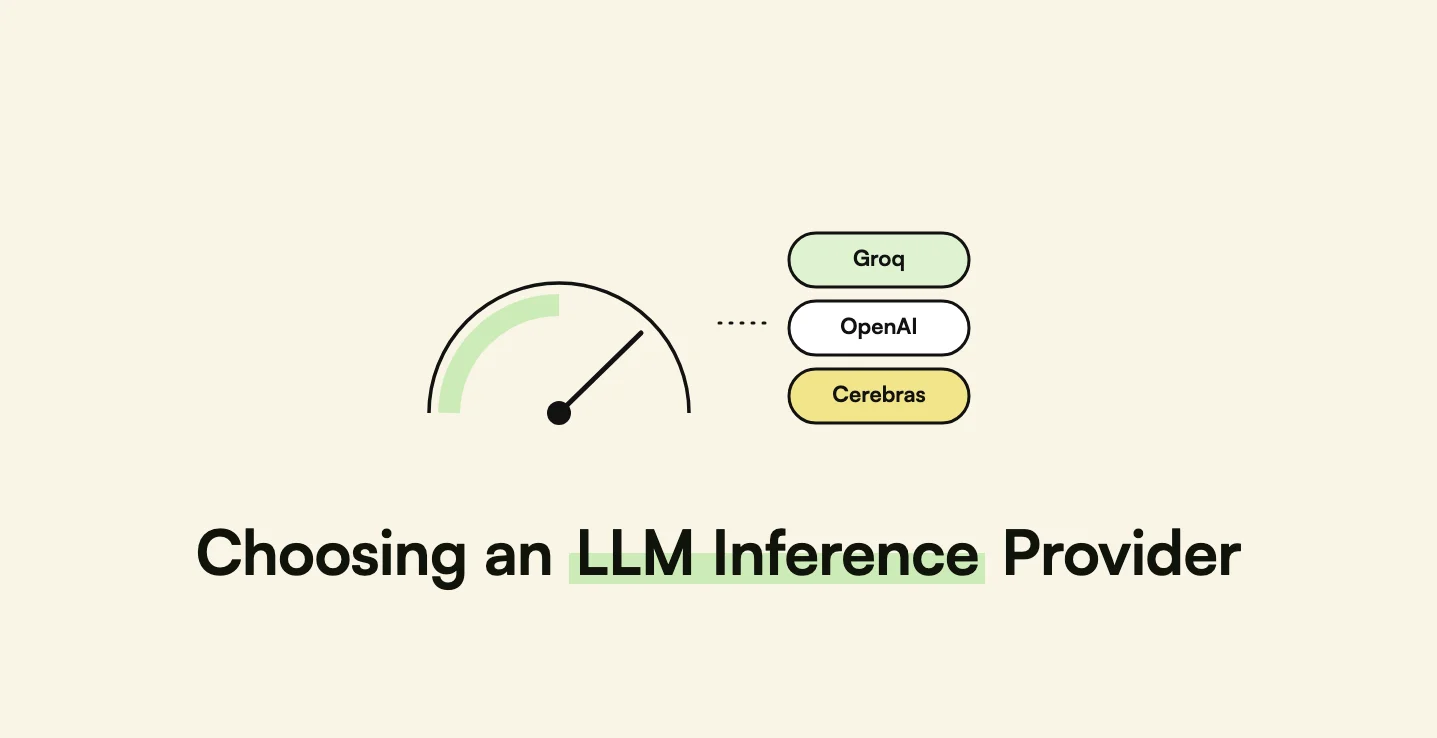
What are the main LLM inference options in 2026?
| Option | What it is | Strengths | Trade-offs |
|---|---|---|---|
| Groq (GroqCloud) | Open-weight models served on Groq's Language Processing Unit hardware | Built for fast, predictable token generation; OpenAI-compatible API | Limited to the models Groq hosts; vendor changes after the Nvidia licence deal |
| Cerebras | Open-weight models served on wafer-scale hardware | Cerebras publishes benchmarks showing high output speed on open models | Limited model catalogue; speed claims vary by model and source |
| OpenAI | Proprietary frontier models, plus the Realtime API for speech-to-speech | Strong reasoning and tool use; native audio models | GPU-served latency varies with load; model choice limited to OpenAI's |
| Google Gemini | Gemini models, plus the Live API for native audio and video streams | Long context, multimodal input, native audio | Same coupling of model and provider |
| Self-hosted GPU | Open-weight models on rented GPUs, such as RunPod or a cloud provider | Full control of model, data location, and fine-tuning | Team owns scaling, uptime, and optimisation |
Speed benchmarks are published by independent groups such as Artificial Analysis and by the vendors themselves, and the results change with the model, input length, and date of the test. AppMatic Tech treats public numbers as a shortlist and measures candidate providers with the product's own prompts, at the product's own concurrency, before committing.
Should a voice app use a pipeline or a speech-to-speech model?
Voice products now have two architectures.
| Factor | Cascaded pipeline (STT, LLM, TTS) | Speech-to-speech model |
|---|---|---|
| Examples | FELA: speech-to-text, Groq LLM inference, a custom language aligner, text-to-speech | OpenAI's Realtime API, Google's Gemini Live API |
| Control | Each stage can be swapped, tuned, or cached | One model handles listening, reasoning, and speaking |
| Custom logic | Business rules can sit between stages | Logic must live in prompts and tool calls |
| Model choice | Any LLM, including fast open-weight models | Limited to the provider's audio models |
| Logging and review | Text exists at every stage, which simplifies moderation and audits | Text transcripts depend on the provider's features |
| Integration effort | Higher, with several services to orchestrate | Lower, with one streaming connection |
AppMatic Tech recommends a speech-to-speech model when the product is a general conversational agent and time to market matters most, and a cascaded pipeline when the product needs domain logic between hearing and speaking, as FELA does to keep vocabulary at the learner's level.
How did AppMatic Tech choose inference for FELA?
FELA is a native iOS and Android AI language tutor with 300,000+ downloads. The product requirement was a spoken reply in under 500 milliseconds, with context kept across a full conversation, at up to 25,000 simultaneous users.
- Budget first. AppMatic Tech allocated the 500ms budget across speech-to-text, LLM inference, the language aligner, text-to-speech, and network handoffs.
- Provider by measurement. GPU-based inference at standard providers could not reliably keep the LLM stage inside its share of the budget, so AppMatic Tech selected Groq's LPU-based inference.
- Microservices per stage. Each stage runs as an independently scalable FastAPI service, with GPU workloads on RunPod, so one stage can scale without scaling the others.
- Fast context. MongoDB stores conversation context, with each fetch kept under 10 milliseconds, and caching cuts repeated inference.
- Load validation. The pipeline was tested at 25,000 concurrent sessions before launch, with no single component becoming a system-wide bottleneck.
The full build is described in the FELA case study.
What does the Nvidia and Groq deal mean for GroqCloud users?
On December 24, 2025, Groq and Nvidia announced a non-exclusive licensing agreement for Groq's inference technology. Founder Jonathan Ross, president Sunny Madra, and other team members joined Nvidia. Groq stated that Groq remains an independent company under chief executive Simon Edwards and that GroqCloud will continue to operate without interruption. Nvidia's annual report describes the deal as a non-exclusive licence plus the hiring of certain Groq employees, with no customer contracts or equity acquired.
For teams running production traffic on GroqCloud, AppMatic Tech's advice is practical rather than alarmed:
- Keep a tested fallback provider for every model in production, which is good practice with any vendor.
- Review contracts and data terms at renewal, since vendor ownership and roadmaps can shift.
- Watch model availability. Fast-inference providers retire and add models often, so evals should be ready to run on replacements.
How should an AI app avoid inference lock-in?
AppMatic Tech builds every AI product with six inference safeguards:
- One internal model interface. Application code calls a single internal service, never a provider SDK directly. Providers with OpenAI-compatible endpoints, such as Groq, plug in with little code.
- Model-agnostic prompts. Prompts avoid provider-specific features unless they are isolated behind the interface.
- An evaluation set. A fixed set of real user inputs is scored for quality on every candidate model, so switching is a measured decision.
- Timeouts and fallback routing. If a provider exceeds the latency budget or returns errors, the request retries on a second provider.
- Per-provider limits. Rate limits and quotas are enforced centrally, so bursts degrade gracefully instead of failing.
- Latency monitoring. Time to first token and total latency are tracked at p50 and p95 per provider and per model.
Pro tip: Load-test with production-shaped prompts. A provider that is fast on a 200-token benchmark prompt can slow sharply on a 6,000-token prompt with conversation history, which is what a real tutoring or support session sends.
Lessons from running LLM features in production are collected in LLM integration in production.
Which inference approach fits which app?
| App type | Recommended approach | Why |
|---|---|---|
| Voice tutor or coach with domain rules | Cascaded pipeline on a fast-inference provider | Control between stages and a tight latency budget |
| General voice assistant or phone agent | Speech-to-speech model | Fewer moving parts and native audio |
| Chat support agent with tools | Frontier model with streaming, plus a fast fallback | Tool use quality matters; streaming hides latency |
| Batch reports and summaries | Cheapest model that passes evals | Latency barely matters; cost does |
| Regulated or data-resident workloads | Self-hosted or region-pinned inference | Data location and audit control |
| On-device features | On-device models | No network round trip at all, as covered in on-device AI for mobile apps |
How AppMatic Tech builds real-time AI products
AppMatic Tech has shipped 330+ products since 2017, holds a 5.0 Clutch rating, and keeps an 83% client retention rate. Real-time AI work includes FELA, with 300,000+ downloads and sub-500ms AI conversation, and Feel Sync, an AI news app that matches articles to user-selected sentiment within two seconds.
AI services are described under AI expertise, and consumer AI products on the consumer AI app development page. Scoping starts at contact@appmatictech.com or the contact page.
Sources
| Claim used in this article | Source |
|---|---|
| Nvidia licence, leadership changes, Groq independence, GroqCloud continuity | Groq, Groq and Nvidia licensing agreement |
| Nvidia's description of the Groq deal | Nvidia, FY2026 annual report |
| Cerebras published speed comparisons with Groq | Cerebras, CS-3 vs Groq LPU |
| Gemini Live API native audio and video streams | Google, Gemini Live API |
| OpenAI Realtime API for speech-to-speech | OpenAI, Realtime API |
| FELA pipeline, Groq selection, FastAPI services, MongoDB context, 25,000 concurrent users | AppMatic Tech, FELA case study |
Frequently Asked Questions
- Is Groq faster than OpenAI?
- Groq runs open-weight models on Groq's Language Processing Unit (LPU) hardware, built for fast token generation, while OpenAI serves OpenAI's proprietary models on GPU infrastructure. Speed depends on the model, prompt length, and load, so the comparison has to be made per model and per workload. AppMatic Tech chose Groq for FELA because the sub-500ms conversation budget needed predictable, fast inference.
- What is the difference between time to first token and throughput?
- Time to first token is the delay before a model starts responding, and throughput is how many tokens per second the model produces once generation starts. Voice and chat apps feel fast when time to first token is low and answers are short. Long-form generation, such as reports, depends more on throughput.
- Is GroqCloud still available after the Nvidia deal?
- Yes. On December 24, 2025, Groq granted Nvidia a non-exclusive license to Groq's inference technology, and founder Jonathan Ross and president Sunny Madra joined Nvidia. Groq stated that Groq remains an independent company under chief executive Simon Edwards and that GroqCloud will continue to operate without interruption.
- Should a voice app use a speech-to-speech model or an STT, LLM, and TTS pipeline?
- A speech-to-speech model, such as OpenAI's Realtime API or Google's Gemini Live API, reduces integration work and handles audio natively. A cascaded pipeline of speech-to-text, an LLM, and text-to-speech gives more control over models, vocabulary, cost, and logging. FELA uses a cascaded pipeline because the product needed a custom language aligner between the LLM and the voice.
- How can an AI app avoid lock-in to one inference provider?
- An AI app avoids inference lock-in by calling models through one internal interface, keeping prompts and evaluation sets model-agnostic, routing to a fallback provider on timeouts or errors, and monitoring p50 and p95 latency per provider. Providers that expose OpenAI-compatible endpoints, such as Groq, make switching cheaper.