



AppMatic Tech replaces WhatsApp-based site coordination with structured construction field apps built in Flutter, where every photo, checklist, and update is attached to a project, stored in a company-owned Laravel and PostgreSQL backend, and searchable in plain language. AppMatic Tech is based in Ahmedabad, India, and its construction platform saved teams 32% of project management time.
Ask a site supervisor in London, Lagos, or Nairobi where this week's progress photos are, and the answer is usually a WhatsApp group. WhatsApp won construction sites for good reasons: it is free, everyone already has it, it works on low-cost Android phones, and voice notes beat typing with gloves on. The trouble starts when a chat tool becomes the company's system of record. This article explains why construction teams lose photos and records in WhatsApp groups, the compliance exposure it creates, and how to move a site team to something better without losing the habit that made WhatsApp work.
Key takeaways
WhatsApp is a good conversation tool and a poor record system.
| Point | Detail |
|---|---|
| Why WhatsApp wins | Free, familiar, works on any phone, voice notes, tolerant of weak signal |
| What it loses | Photos on personal phones, no project tags, compressed images, no audit trail |
| The compliance risk | Company records and personal data outside company control and retention |
| The replacement pattern | Keep chat for talk, move photos, logs, checklists, and sign-offs to a field app |
| Adoption rule | The new app must be faster than WhatsApp for taking and sharing photos |
| Measured result | 32% of project management time saved after replacing WhatsApp and spreadsheets |
Why do construction teams run projects on WhatsApp?
WhatsApp runs construction sites because it removes every barrier to sharing information in the field. Nobody needs a login, training, or a company device. A photo, a voice note, and a location pin reach the whole team in seconds.
The client's own discovery for AppMatic Tech's construction platform listed "WhatsApp plus spreadsheets" as the main incumbent, alongside Procore, PlanGrid, and Fieldwire. Its advantages were real: zero tool cost, immediate accessibility on any device, and no onboarding. Any replacement has to match those advantages before it can fix WhatsApp's weaknesses.
What goes wrong when a construction project runs on WhatsApp groups?
The problems appear slowly, then all at once, usually when someone needs a record that is six months old.
| Problem | What happens | Business consequence |
|---|---|---|
| Records live on personal phones | Photos and messages sit in each person's device storage | When a supervisor leaves or loses a phone, the project record goes with them |
| No project context | A photo has a sender and a time, not a project, area, or activity | Photos cannot be filtered by site or work area later |
| Images are compressed | Chat apps reduce image quality by default to save data | Detail needed for defects or disputes can be lost |
| Search means scrolling | Finding a photo means scrolling through months of mixed messages | Supervisors re-shoot work that was already documented |
| No structured fields | Checklists and sign-offs arrive as free text or photos of paper | Compliance reports are assembled by hand |
| Mixed audiences | Subcontractors, clients, and staff share groups | Sensitive information reaches people who should not have it |
| No audit trail | Messages can be deleted or edited outside company oversight | Records are hard to rely on in a claim or an investigation |
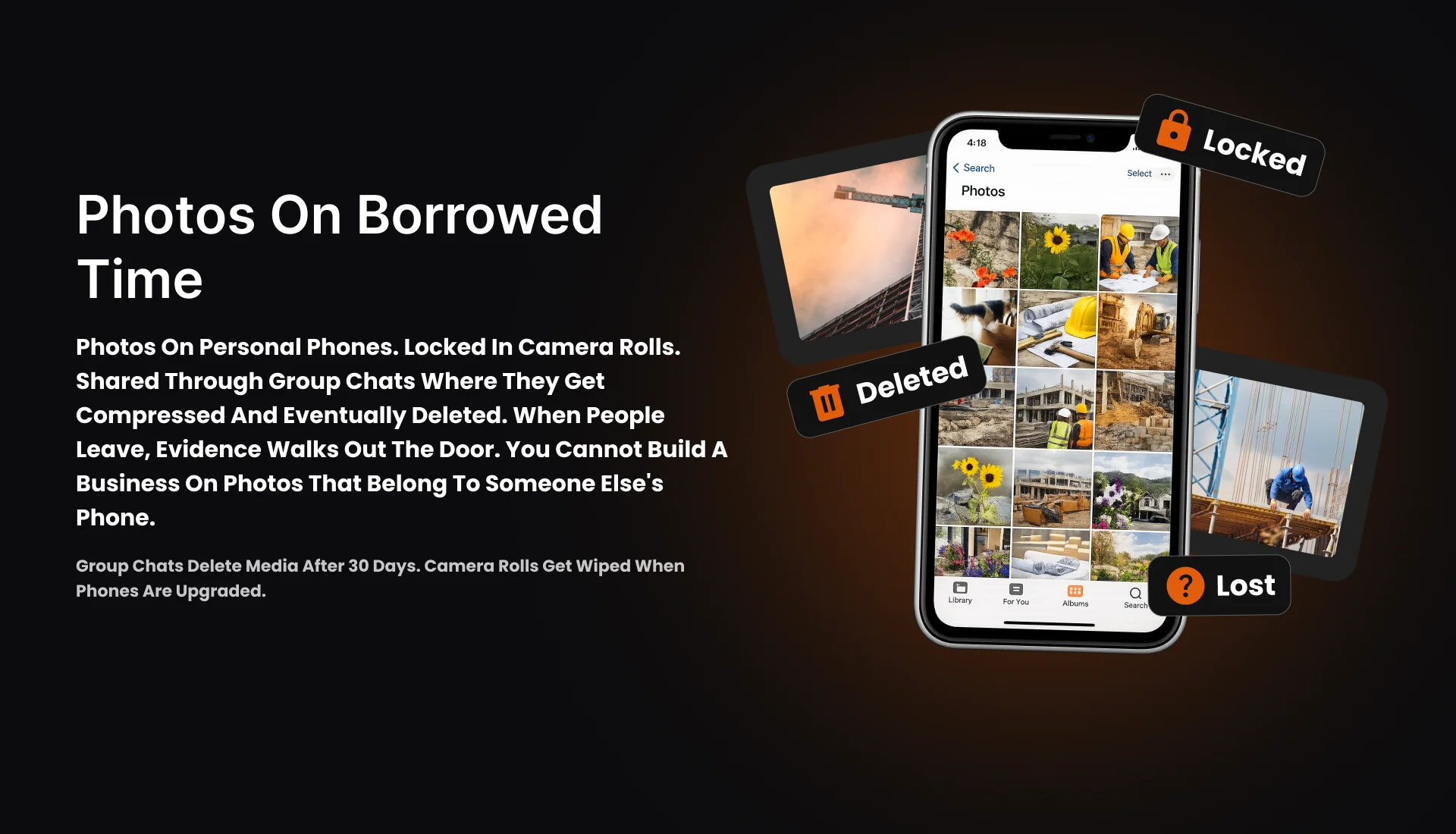
None of these are failures of WhatsApp as a messaging app. They are the result of using a messaging app as a document system. The capture and tagging standard a real photo system needs is set out in construction site photo documentation.
Is WhatsApp a compliance risk for construction companies?
It can be. When project records, worker photos, and client information sit on personal devices, the company cannot apply its own retention rules, remove access when someone leaves, or show who changed what. Two kinds of obligation are affected.
- Record-keeping obligations. Safety files, inspection records, and project documentation are expected to be complete and retrievable. Records scattered across personal chat histories are neither.
- Data protection obligations. Photos of workers, ID documents shared for site access, and client details are personal data. Laws such as UK GDPR, South Africa's Protection of Personal Information Act (POPIA), Kenya's Data Protection Act 2019, and Nigeria's Data Protection Act 2023 expect organisations to control the personal data they process.
This article is not legal advice. A company that relies on WhatsApp for records should confirm its obligations with counsel. The record-keeping rules for safety documentation by country are compared in audit-ready construction safety records.
What should replace WhatsApp groups on a construction site?
The replacement is a split: keep chat for conversation, and move records into a structured system. The options below differ in how much structure they add.
| Option | What it does | Best for |
|---|---|---|
| Keep WhatsApp, export regularly | Someone copies photos and files into project folders each week | Very small firms, as a stopgap only |
| Construction chat app | Chat organised by project, with photos stored per project | Teams that mainly need organised conversation |
| Off-the-shelf field app | Photos, checklists, and daily logs captured against projects | Firms whose workflow matches the product |
| Custom offline-first field app | Capture, tagging, sync, and search designed around the company's workflow and connectivity | Mid-size firms with many sites, poor signal, or unusual workflows |
When a company runs many sites, has crews in low-connectivity areas, or wants AI search across its records, a custom field app usually pays back fastest. The trade-offs against platforms such as Procore are compared in custom construction software vs Procore.
How do you move a site team off WhatsApp without losing adoption?
Crews abandon any tool that is slower than WhatsApp for the thing they do most often, which is taking and sharing a photo. The rollout below is built around that rule.
- Start with photos only. Do not launch checklists, logs, and forms on day one. Make photo capture the first habit.
- Make it faster than WhatsApp. Open straight to the camera inside the current project, so the project tag is applied with no extra tap.
- Make it work with no signal. Photos must save instantly and upload later. An app that spins while looking for signal loses to WhatsApp immediately.
- Keep voice notes. Let supervisors attach voice notes to photos and records, then transcribe them.
- Onboard with a QR code. On AppMatic Tech's platform, a project admin shares a QR code and crew members scan it to join the right company and projects.
- Run both in parallel on a pilot site. Two weeks of overlap on one site shows the team that nothing is lost, then WhatsApp goes back to being for conversation only.
Pro tip: Measure the switch with one number: how many photos per week are captured in the field app compared with the WhatsApp group. When the app count is higher for two weeks running, the habit has moved.
How does WhatsApp use on sites differ across the UK, US and Africa?
The dependency on WhatsApp, and the cost of replacing it, varies by market.
| Region | How sites use WhatsApp | What the replacement must handle |
|---|---|---|
| United Kingdom | Common on most sites for photos, updates, and subcontractor coordination | Records that feed the CDM 2015 health and safety file and, for higher-risk buildings, the golden thread |
| United States | Text messaging and project platforms are more common; WhatsApp is widely used among multilingual crews | Integration with platforms such as Procore, and records suitable for claims and OSHA documentation |
| Africa (Kenya, Nigeria, Egypt, Ethiopia, Tanzania, South Africa) | The default coordination tool on most sites, because it works on mid-range Android phones and patchy networks | Full offline capture, low data use, multiple languages, and a share-out path back to WhatsApp for clients and subcontractors |
In African markets the replacement cannot pretend WhatsApp does not exist. A practical design captures the record in the field app and lets a supervisor share a generated photo report or link into WhatsApp for clients and subcontractors who will never install another app. The broader requirements for African sites are covered in construction technology in Africa 2026.
What AppMatic Tech replaced WhatsApp with
AppMatic Tech has shipped 330+ products since 2017 with an 83% client retention rate and a 5.0 Clutch rating. For its construction project management platform, AppMatic Tech replaced WhatsApp-and-spreadsheet coordination with an offline-first Flutter app for iOS and Android, a Laravel backend on PostgreSQL with data isolated per company, and a Construction MCP Server that lets managers search photos and project records in plain language through Claude and GPT-4. The platform manages 100+ projects and saved teams 32% of project management time.
The engineering that lets photos save without signal is explained in how offline-first construction apps sync field data. Builds by trade and company type are listed under construction software by role, and the service scope is on the construction technology service page. Contact AppMatic Tech at contact@appmatictech.com to plan a move off WhatsApp.
Sources
| Claim used in this article | Source |
|---|---|
| WhatsApp plus spreadsheets as incumbent, its advantages and disadvantages, 32% time saved | Construction project management platform case study |
| QR code sharing in the offline-first field app | Construction industry page |
| UK GDPR obligations | Information Commissioner's Office |
| South Africa POPIA | Information Regulator South Africa |
| Kenya Data Protection Act 2019 | Office of the Data Protection Commissioner, Kenya |
| Nigeria Data Protection Act 2023 | Nigeria Data Protection Commission |
Frequently Asked Questions
- Why is WhatsApp a problem for managing construction sites?
- WhatsApp is a problem for managing construction sites because project records end up on personal phones instead of company systems, photos carry no project or location tags, images are compressed by default, there is no structured audit trail, and finding an old photo means scrolling. When a supervisor leaves or changes phones, the records leave too. AppMatic Tech replaces these records with structured field apps owned by the company.
- What should construction companies use instead of WhatsApp groups?
- Construction companies should keep chat for conversation and move records into a structured field app: photos, daily logs, checklists, and sign-offs captured against a project and stored in a company-owned backend. Options range from construction chat apps to off-the-shelf field apps to a custom offline-first app. AppMatic Tech builds custom Flutter field apps with a Laravel and PostgreSQL backend for firms whose workflows or connectivity need it.
- Is using WhatsApp for construction project records a compliance risk?
- Using WhatsApp for construction project records can be a compliance risk because the records sit on personal devices outside company retention, access control, and audit processes. Data protection laws such as UK GDPR, South Africa's POPIA, Kenya's Data Protection Act 2019, and Nigeria's Data Protection Act 2023 expect organisations to control personal data they process. Companies should confirm their obligations with legal counsel.
- How do you get a construction site team to stop using WhatsApp?
- A construction site team stops using WhatsApp when the replacement is faster for the job they do most: taking and sharing photos. Start with photos only, make the app work offline, apply the project tag automatically, keep voice notes, onboard crews with a QR code, and run both tools in parallel for two weeks on a pilot site before switching.
- Does AppMatic Tech's construction app replace WhatsApp completely?
- AppMatic Tech's construction platform replaces WhatsApp for project records, meaning photos, checklists, compliance documentation, and status, while teams can keep a chat tool for informal conversation. The client's competitive analysis listed WhatsApp plus spreadsheets as the incumbent, with photos lost in chat threads and no search across project history. The platform saved teams 32% of project management time.