

Travel CRM That Has Processed 50 Million+ Enquiries Without a Single Bottleneck
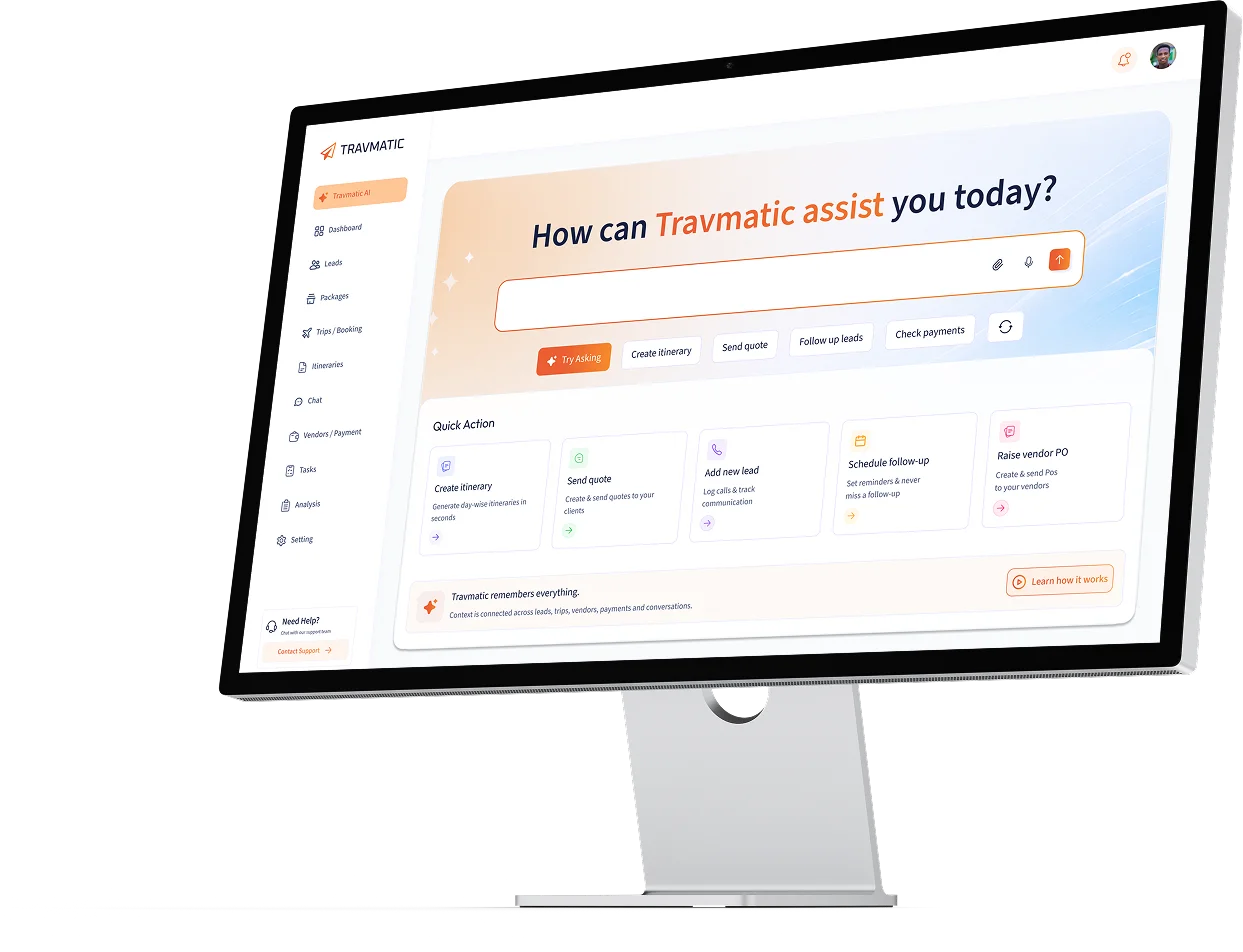
AppMatic Tech built a role-based travel CRM SaaS from scratch on Laravel, React, MySQL, and Redis for a travel operator that has since served over 10 million users and processed over 50 million customer enquiries and packages. The platform covers lead management, itinerary building, vendor expense processing, payout management, and a full RBAC permission engine from Ahmedabad, India.
Why Travel Agencies at Scale Cannot Manage Enquiries Without a Purpose-Built CRM
A travel agency managing 1,000 enquiries per month can operate on spreadsheets, WhatsApp threads, and shared email inboxes. A travel operator managing millions of enquiries per year cannot. Without a system that assigns leads to agents, tracks every stage of the sales pipeline, records every version of a quote, and automates the financial settlement with vendors, the operation accumulates data loss, missed follow-ups, pricing errors, and audit gaps that compound directly into revenue leakage.
The specific problems the travel CRM client brought to AppMatic Tech: lead assignment was manual and inconsistent across branches, agents were building itineraries and package quotes in separate spreadsheets that had no version control, vendor expenses were tracked in a separate finance tool that was not connected to booking records, and payout calculations required manual reconciliation every settlement cycle. As enquiry volumes grew, every manual process degraded proportionally.
AppMatic Tech built the complete system from scratch: RBAC engine, five core operational modules, and an infrastructure architecture designed to serve the enquiry volume the client's business would reach, not just the volume it had at the time of build.
How a Purpose-Built Travel CRM Compares to Generic CRM Platforms
Generic CRM platforms offer lead management but not travel-specific workflows. Purpose-built travel back-office platforms offer workflows but at enterprise pricing with rigid configuration. AppMatic Tech's custom-built approach delivers travel-specific functionality with full ownership of the codebase, data model, and infrastructure.
| Feature | AppMatic Travel CRM | Salesforce | Zoho CRM | Lemax |
|---|---|---|---|---|
| Travel-Specific RBAC | 6 roles, API-enforced | Configurable (complex setup) | Generic roles | Built-in |
| Itinerary Builder | Day-wise drag-and-drop | Not available | Not available | Available |
| Package Costing Engine | Auto-calculates per-person | Not available | Not available | Available |
| Vendor Expense and Payout | Full module | Requires custom dev | Requires custom dev | Available |
| Scale at 50M+ Enquiries | Validated | Yes (at enterprise cost) | Not designed for this | Not documented |
| Redis Caching Layer | Built-in | Platform-managed | Platform-managed | Not configurable |
| Server Cost Control | Custom AWS architecture | Vendor-controlled | Vendor-controlled | Vendor-controlled |
| Ownership | Full source code | SaaS subscription | SaaS subscription | SaaS subscription |
What AppMatic Tech Built
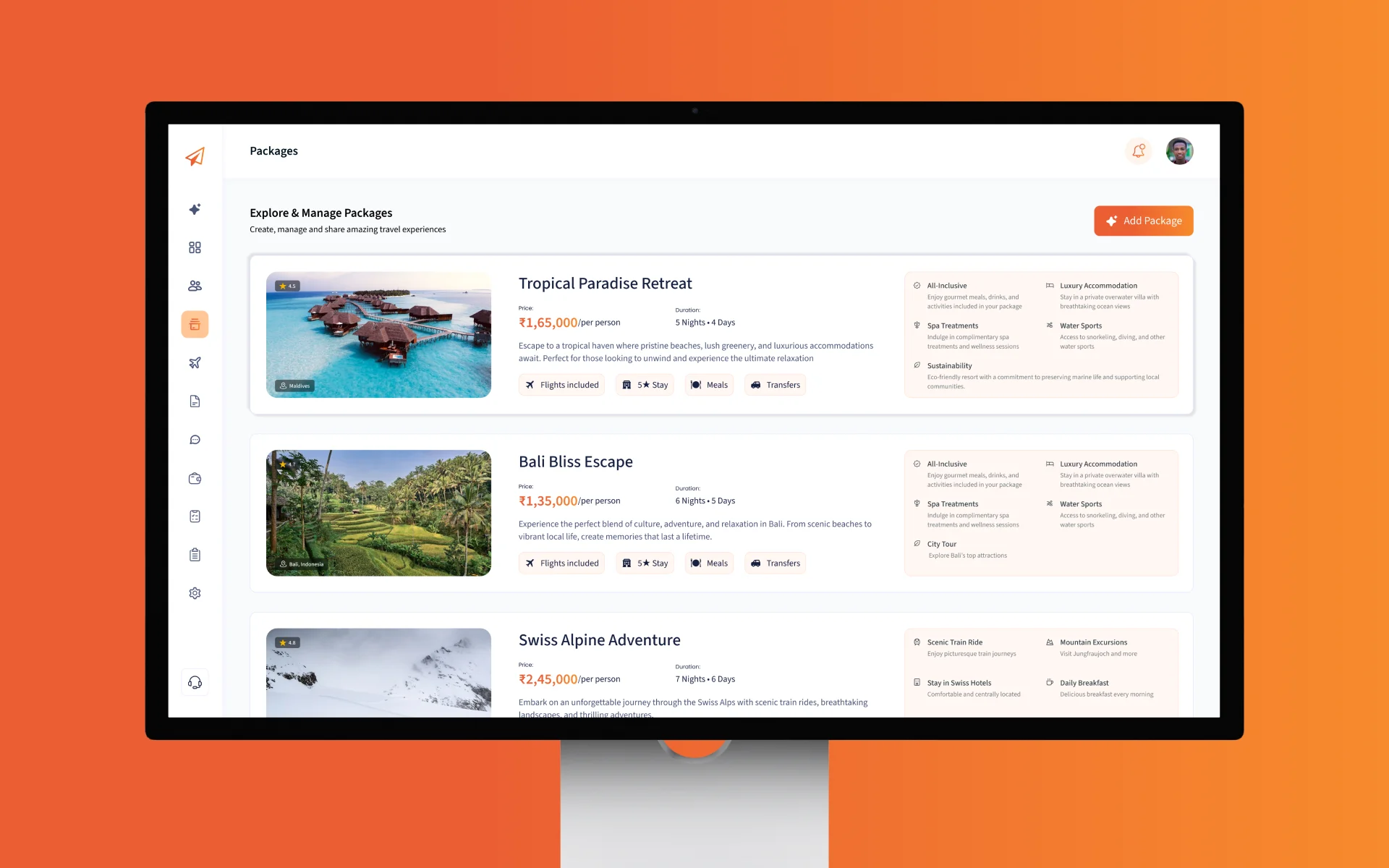
AppMatic Tech designed and built five operational modules and the performance infrastructure to run all of them at 50 million+ enquiry scale.
- RBAC Permission Engine
- API-level role enforcement across six user roles: Super Admin, Branch Manager, Senior Travel Agent, Travel Agent, Finance Manager, and Vendor. Permissions are validated at the API middleware layer on every request. Each data object (lead, itinerary, package, payout) has access rules scoped to role and ownership.
- Lead Management Module
- Customer enquiries enter the system as leads through web forms, API ingestion, or manual entry. The module handles lead assignment by branch rules or manual allocation, a five-stage status pipeline (New, Contacted, Quoted, Booked, Closed), activity logging for every agent interaction, follow-up scheduling, lead source attribution, and bulk operations for reassignment and status updates.
- Travel CRM Package Costing Engine
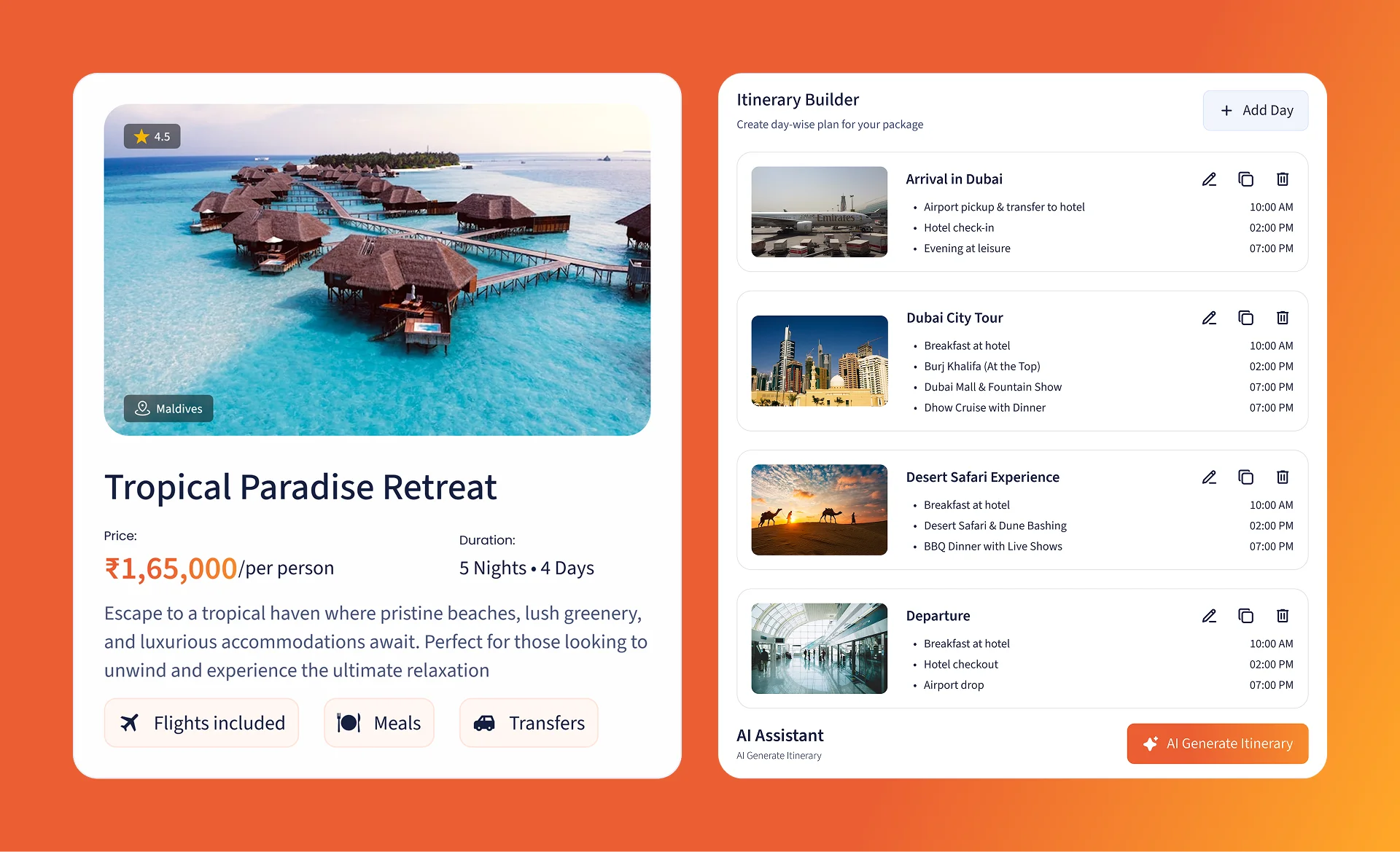
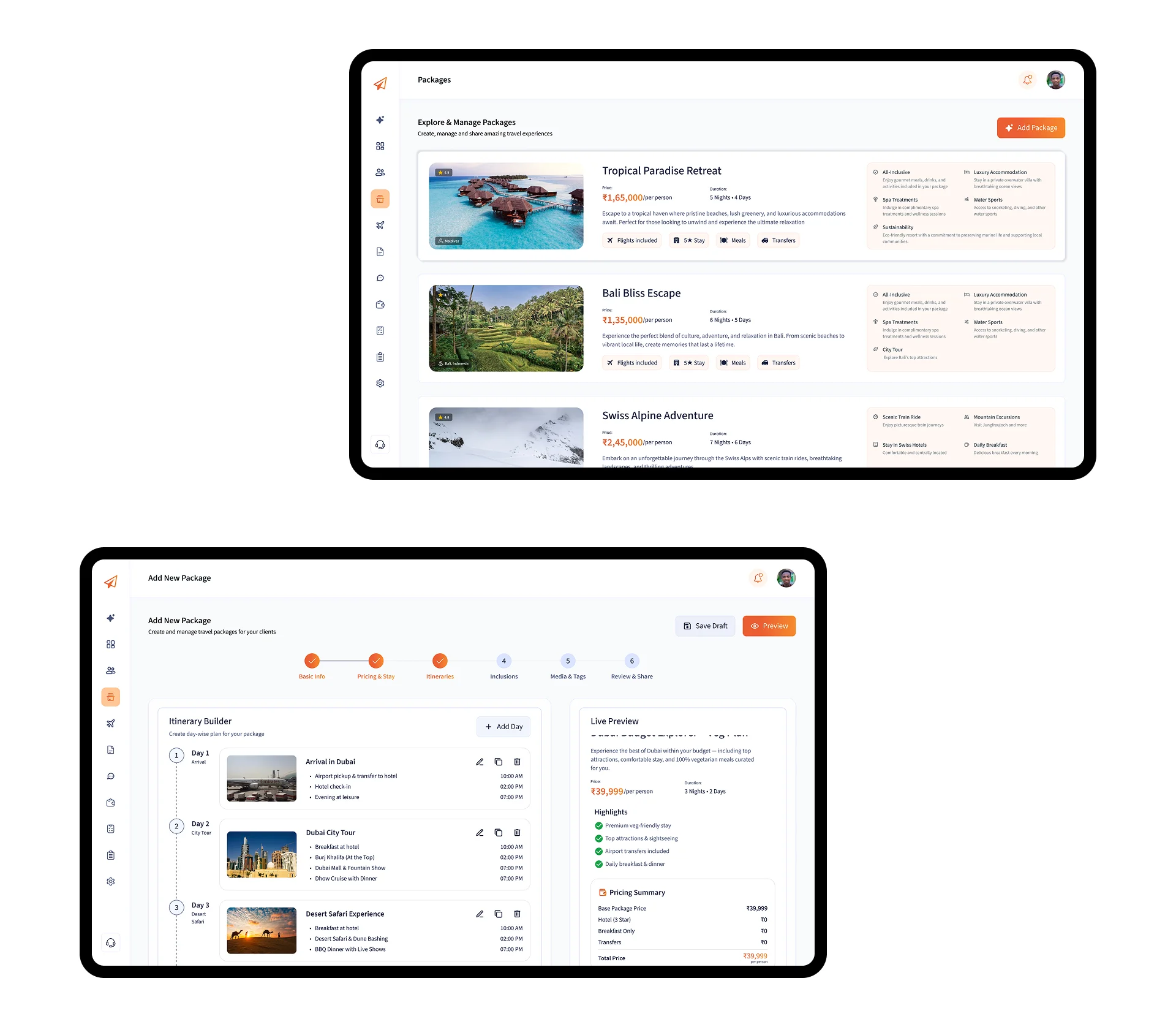
- Agents build day-wise itineraries from a managed destination and component library (hotels, transport, activities, attractions). The costing engine auto-calculates per-person package pricing from component costs, margin configuration, group size, and seasonal rate adjustments. Multiple quote versions per enquiry are maintained independently.
- Itinerary Builder
- Drag-and-drop day-wise itinerary sequencing with a component library for hotels, transport, activities, and destinations. Package templates capture frequently-sold tour routes for one-click itinerary initialisation. PDF itinerary generation renders the finalised itinerary as a branded customer presentation document, processed asynchronously via the queue layer.
- Vendor Expense and Payout Management
- Vendors are onboarded with service categories and rate cards. Agents submit expenses against confirmed bookings from their assigned package portfolio. The finance team reviews and approves expenses, and the payout calculation module computes settlement amounts per vendor per period, with a vendor ledger showing running balance of due vs paid.
- Travel CRM Queue-First Architecture
- All non-synchronous operations run through Laravel Queue workers backed by Redis: PDF itinerary generation, bulk lead operations, email notifications, report generation, and payout calculations. Heavy operations are processed asynchronously, maintaining sub-200ms web response times regardless of background workload volume.
- Redis Caching Layer
- High-frequency read data, including destination libraries, package templates, agent lists, branch configurations, and report aggregates, is cached in Redis with mutation-triggered invalidation. Cache hit rates on read-heavy endpoints exceed 85%, reducing MySQL RDS read load to a fraction of what the enquiry volume would otherwise require.
- Reporting and Analytics Dashboard
- Lead conversion funnel by agent, branch, and lead source. Revenue reports by destination, package type, and time period. Agent performance metrics, vendor expense summaries, and outstanding payout reports. All reports are generated asynchronously and cached, with CSV export for finance and management workflows.
Delivery Metrics
- Users Served
- 10M+
- Enquiries Processed
- 50M+
- Cache Hit Rate
- 85%+
"The scale at which this platform operates is something none of us anticipated when we first scoped the project. AppMatic Tech built an architecture that has never needed emergency intervention, never produced a billing surprise, and has continued to perform without degradation as we passed 10 million users and 50 million enquiries. The queue architecture and Redis caching layer are the two decisions that made everything else possible."
Travel Agency Owner

Platform Specifications
| Metric | Value |
|---|---|
| Platform Type | Custom B2B SaaS (Web) |
| Users Served | 10,000,000+ |
| Enquiries Processed | 50,000,000+ |
| Packages Generated | 50,000,000+ |
| RBAC Roles | 6 (Super Admin, Branch Manager, Senior Agent, Agent, Finance, Vendor) |
| Core Modules | 5 (RBAC, Leads, Itinerary/Packages, Vendor Payouts, Reporting) |
| Frontend | React |
| Backend | Laravel (PHP) |
| Database | MySQL (composite indexes, date partitioning) |
| Cache Layer | Redis (85%+ hit rate on read-heavy endpoints) |
| Queue System | Laravel Queues (Redis-backed) |
| Infrastructure | AWS (EC2, RDS, ElastiCache, S3) |
| Build Type | Built from scratch |
Tech Stack
- React
- Frontend framework
- Laravel
- Backend API and business logic
- PHP
- Backend language
- MySQL
- Relational database with composite indexes and date partitioning
- Redis
- Caching and queue backend
- AWS
- Cloud infrastructure (EC2, RDS, ElastiCache, S3)
- Tailwind CSS
- Frontend styling
- Node.js
- Build tooling and frontend dev server


Security and Operational Standards
A CRM handling financial records, vendor payouts, and 50 million+ customer enquiries requires strict access control, immutable audit logging, and infrastructure monitoring.
- API-Layer RBAC Enforcement
RBAC permissions are enforced at the Laravel API middleware layer on every authenticated request. UI-level permission hiding is a UX convenience only, not a security boundary.
- Immutable Audit Logging
All write operations on lead status, package finalisation, expense approval, and vendor selection are written to an immutable audit log table with timestamp, actor user ID, actor role, and old/new state. Payout disputes and pipeline reviews are fully auditable.
- Encrypted Vendor Financial Data
Vendor financial data (rate cards, bank settlement details) is stored encrypted at rest and accessible only to Finance Manager and Super Admin roles via dedicated endpoints.
- Queue Health Monitoring and Cache Failover
Laravel Horizon monitors queue worker health with alerting on depth spikes. Redis ElastiCache is configured with automatic failover so cache unavailability degrades gracefully to direct DB reads without downtime.
- Exception Tracking and Slow Query Monitoring
Structured exception tracking in production surfaces errors before they reach users. Database slow query logging flags any query exceeding 200ms for index optimisation review.
How AppMatic Tech Approached This Build
Workflow Discovery and Data Model Design
AppMatic Tech mapped the client's existing lead, enquiry, booking, and vendor settlement workflows across branches and agent tiers before any development began. The database schema for leads, itineraries, packages, bid items, and audit records was reviewed with the client's operations head and signed off before code was written.
Phase 1
RBAC Architecture and User Management
AppMatic Tech designed the role hierarchy and permission matrix, implemented the API-level middleware enforcement, and built the user management module with role assignment, branch membership, and permission audit logging before any feature modules were developed. RBAC correctness was validated before any data-sensitive module was built on top of it.
Phase 2Lead Management and Sales Pipeline
AppMatic Tech built lead capture, assignment rules, status pipeline, activity logging, follow-up scheduling, and bulk operations. Load testing of lead list and filter queries ran against 10 million record volumes before proceeding to package modules.
Phase 3Itinerary Builder and Package Costing Engine
AppMatic Tech built the destination library, day-wise itinerary builder, package costing logic, multi-version quote management, and PDF generation via the queue layer. PDF generation latency was profiled and confirmed under 3 seconds for a 10-day itinerary via async processing.
Phase 4Vendor Expense and Payout Module
AppMatic Tech built vendor onboarding, expense submission workflow, finance review and approval, payout calculation, and the vendor ledger. Reconciliation logic was validated against manual calculations on test data before production deployment.
Phase 5Performance Optimisation and Infrastructure Sizing
Redis caching layer was configured and hit rates measured. MySQL composite indexes and table partitioning were validated on a 50 million row dataset. Queue worker scaling was configured via Laravel Horizon. AWS infrastructure was sized to the validated load profile with CloudWatch auto-scaling rules configured before launch.
Phase 6
Services Behind This Build
This travel CRM combined custom SaaS engineering, travel-specific workflow design, and growth-focused performance architecture. Explore the AppMatic Tech services that map directly to this product build.




Explore More Craft
Explore More
Hungry Hub
MetaReady
Start a Travel SaaS Project with AppMatic Tech
All projects begin with a no-cost Discovery and Technical Scoping session. Contact the team at contact@appmatictech.com.
Start a Project