


AppMatic Tech builds AI-native products, in which the data schema, inference layer, and fallback behaviour are designed for the LLM before any code is written, rather than bolting AI onto a finished app, as shipped in FELA, Anvahi, and MetaReady on Flutter, React, Next.js, and Laravel. AppMatic Tech is based in Ahmedabad, India, with 330+ products shipped since 2017.
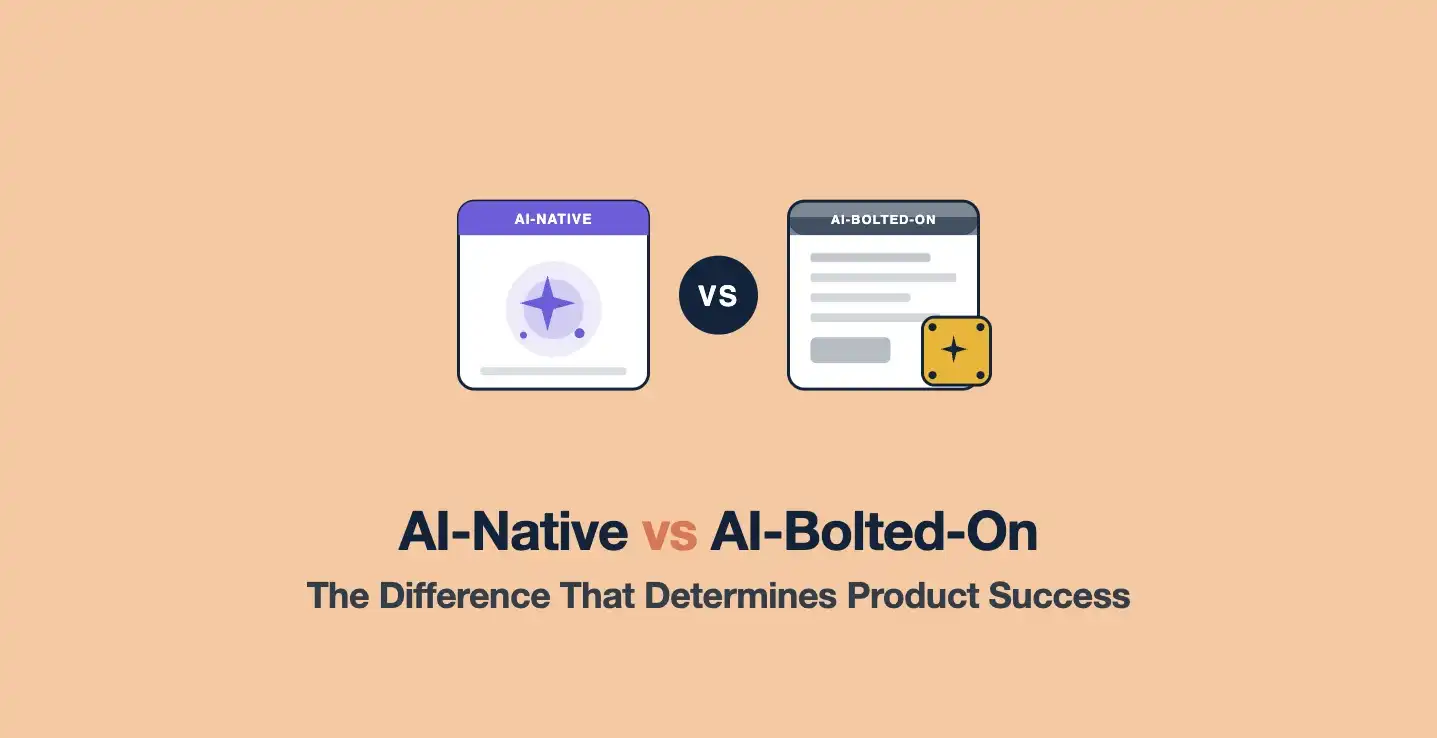
Every agency selling AI development services in 2026 describes what it builds as AI-native. The term has been stretched far enough that it now covers two fundamentally different things: products where the AI capability is designed into the architecture from the start, and products where an AI feature was added to an existing or newly built application after the core product was designed.
The distinction matters because the two architectures produce different products at production scale. The difference is not visible in a demonstration. It becomes visible six months after launch when the AI feature needs to improve, when the product needs to scale to ten times the initial user volume, or when a latency requirement that was acceptable at MVP becomes a product problem as usage grows.
AppMatic Tech has shipped AI-native products including Anvahi, FELA, and MetaReady. The criteria below are specific and testable. They are the questions a founder or CTO should ask any agency claiming to build AI-native products.
What does an AI-bolted-on product look like?
An AI-bolted-on product follows a consistent pattern. The product is designed as a traditional application: data model, API layer, frontend. At some point in the build, an AI feature is added. The feature is typically implemented by calling an LLM API from an existing endpoint, constructing a prompt from data that was not structured for LLM consumption, and returning the response to the interface through a path that was not designed to handle inference latency.
The symptoms of a bolted-on AI integration appear predictably. The AI feature is slower than the rest of the product because the data payload assembled for the LLM is larger than necessary and the inference call is synchronous in a path that was not designed for it. The AI feature is inconsistent because the data it receives is formatted for display rather than for reasoning. The AI feature is expensive to run because it sends maximum available context on every request rather than the minimum context required for the specific query. And the AI feature is difficult to improve because changes to the prompt or the model touch data structures that were not designed with that flexibility in mind.
None of these symptoms are caused by the AI technology being inadequate. They are caused by the integration architecture.
What does an AI-native product look like?
An AI-native product makes three architecture decisions before the data model is designed, before the API layer is built, and before any frontend work begins.
The data schema is designed for LLM consumption alongside application display. Fields that the LLM will reason over are structured and typed rather than stored as blobs. Relationships the LLM will traverse are explicit. Metadata the LLM needs to interpret a record correctly is stored with the record rather than derived from context. This does not require a separate data model. It requires that LLM query patterns are treated as first-class requirements during schema design rather than as an afterthought.
Inference is called at the backend service layer with a minimal, structured payload. An AI-native product does not construct the LLM prompt by serialising application state or UI data. It constructs a minimal payload by querying only the fields the LLM needs for the specific inference task. The inference call is made at the layer in the stack that has direct access to that structured data, not at the layer that is farthest from it.
Fallback and degradation behaviour is defined before the first sprint. In an AI-native product, the LLM is in the critical path of the core user action. That means the product needs defined behaviour for when inference is slow, unavailable, or returns an output that does not pass validation. An AI-bolted-on product treats AI unavailability as an edge case to be handled later. An AI-native product treats it as a requirement to be designed for upfront.
Which three questions reveal whether an agency builds AI-native?
Where in the stack does inference get called, and why?
An agency building AI-native products will answer this specifically: inference is called from the backend service layer, co-located with the data access logic, because that is where the structured data the LLM needs is available with the lowest transformation overhead. An agency that has bolted AI onto an existing pattern will give a vague answer or describe a frontend or middleware call.
How was the data schema designed to support the LLM's query patterns?
An agency building AI-native products will describe specific schema decisions made for LLM consumption: which fields are structured rather than stored as text blobs, how metadata is stored to give the LLM interpretive context, which relationships are made explicit to reduce join complexity for LLM queries. An agency that has not made these decisions cannot describe them.
What is the fallback behaviour when inference is unavailable?
An agency building AI-native products will describe a specific fallback state: the interface renders in a defined degraded mode, operations queue for when inference recovers, or an alternative non-AI path is provided. An agency that treats this as an edge case will not have a specific answer.
Why does AI-native architecture matter at production scale?
The architectural difference between AI-native and AI-bolted-on is most visible in three production scenarios.
Latency at scale. An AI-native product that calls inference with a 500-token structured payload returns faster than an AI-bolted-on product that assembles a 4,000-token context payload from serialised application state, at every level of concurrent load. The latency difference at low user volumes is noticeable. At production user volumes, it is the difference between a usable product and one that requires a loading indicator on the AI feature.
Cost at scale. An AI-native product that sends minimum necessary context on every inference call costs a fraction of an AI-bolted-on product that sends maximum available context. At 100,000 monthly active users, the per-user inference cost difference between a well-designed context payload and an over-specified one is material.
Improvement velocity. An AI-native product can improve its AI behaviour by changing the prompt, the model, or the structured data the LLM receives without touching the application data model or the API layer. An AI-bolted-on product's AI feature is coupled to data structures that were not designed for it, which means improvements require coordinated changes across multiple layers.
How does AppMatic Tech build AI-native products?
AppMatic Tech builds AI-native products where the three architecture decisions above are made in the discovery and design phase before implementation begins. The engagement starts with a data model review that explicitly maps LLM query patterns to schema decisions, defines the inference call location and payload construction approach, and documents the fallback behaviour for each AI-dependent user flow.
FELA's sub-500ms response latency, Anvahi's reliable performance in a live clinical environment, and MetaReady's 13-module AI integration each resulted from this approach. For the specific architecture decisions that produced those outcomes, see How AppMatic Tech Architects AI-Native Products.
For the production failure modes that appear when these decisions are deferred, see LLM Integration in Production: What Nobody Tells You Before You Build.
For an AI-native product example, see how AppMatic Tech built Feel Sync, an AI-powered news application that matches articles to user-selected emotional sentiment. Full engagement details are on the AI engineering services page. Contact AppMatic Tech at contact@appmatictech.com.
Frequently Asked Questions
- What is the difference between AI-native and AI-bolted-on?
- An AI-native product is designed for LLM inference before the first schema decision: data is structured for the model, inference runs at the backend service layer with a minimal payload, and fallback behaviour is defined up front. An AI-bolted-on product adds an LLM call to an app designed without it, which AppMatic Tech finds makes the feature slower, costlier, and harder to improve.
- What are the symptoms of a bolted-on AI feature?
- Four symptoms appear predictably: the AI feature is slower than the rest of the product, inconsistent because its data is formatted for display rather than reasoning, expensive because it sends maximum context on every request, and hard to improve because prompt or model changes touch data structures never designed for them.
- How can you tell whether an agency really builds AI-native products?
- Ask three questions: where in the stack is inference called and why, how was the data schema designed for the LLM's query patterns, and what happens when inference is unavailable. AppMatic Tech expects specific answers, such as backend-layer inference, structured fields instead of text blobs, and a defined degraded mode; vague answers indicate a bolted-on approach.
- Does AI-native architecture reduce LLM costs?
- Yes. An AI-native product builds a minimal, structured payload for each inference call, for example around 500 tokens instead of a 4,000-token dump of serialised application state. AppMatic Tech finds that difference in per-request cost becomes material at production volumes such as 100,000 monthly active users, and it also lowers latency.
- What should an AI product do when the model is unavailable?
- Follow a fallback designed before the first sprint: render the interface in a defined degraded mode, queue operations until inference recovers, or offer a non-AI path. AppMatic Tech treats model unavailability as a requirement in AI-native builds, because the LLM sits in the critical path of the core user action.