


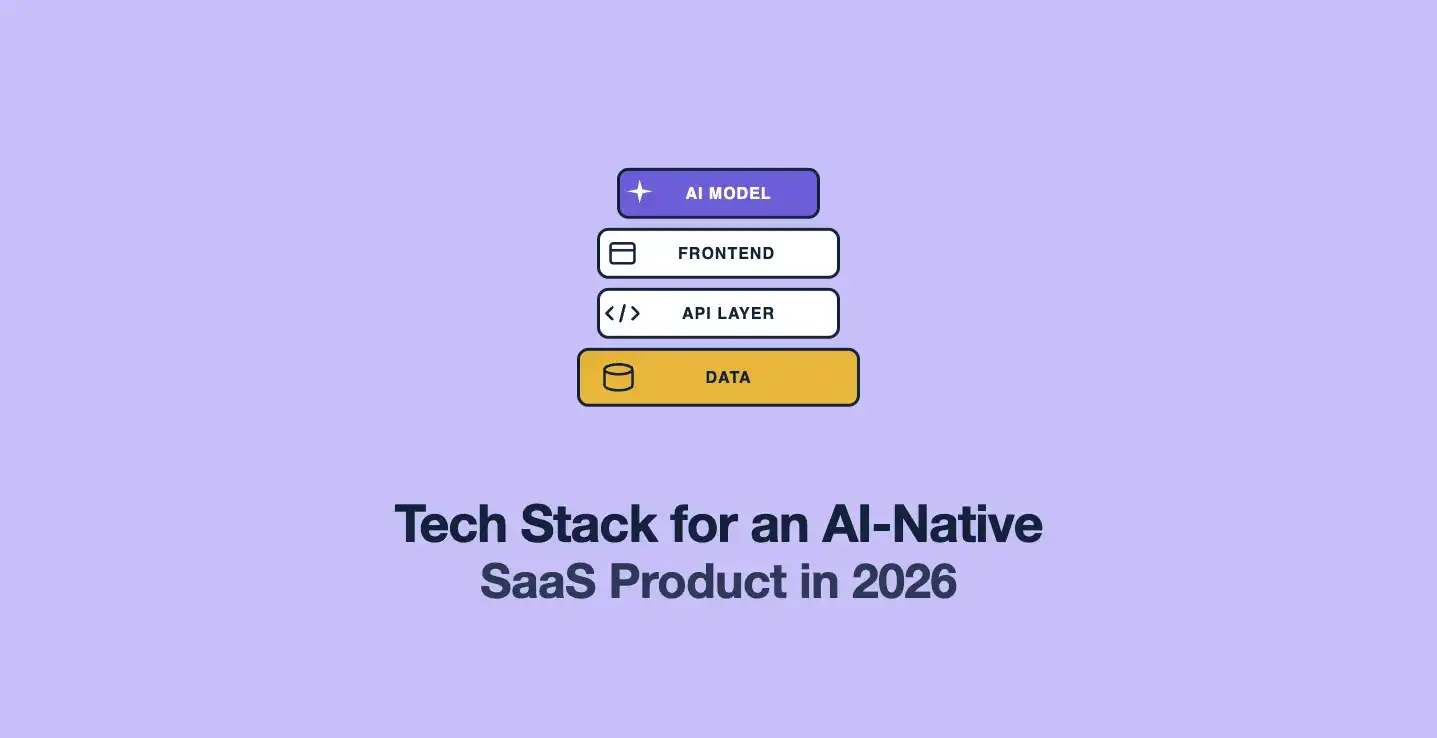
AppMatic Tech's default AI-native SaaS stack in 2026 is Flutter for mobile, Next.js for web, Node.js with TypeScript or Laravel for the backend, PostgreSQL with pgvector for data and early RAG, Anthropic Claude with provider routing, and a custom MCP server for live data. AppMatic Tech is based in Ahmedabad, India, with 330+ products shipped since 2017.
Choosing a tech stack for an AI-native SaaS product in 2026 involves decisions that did not exist three years ago. The LLM integration layer introduces new constraints: where inference is called in the stack, how the database schema supports LLM query patterns, how streaming responses are handled at the API layer, and which model provider APIs the product depends on. These decisions interact with the standard stack choices around mobile framework, backend language, and database in ways that are not obvious during early prototyping.
AppMatic Tech has shipped AI-native SaaS products on Flutter, React Native, React, Next.js, Laravel, Node.js, and PostgreSQL, combined with LLM integrations for Claude, OpenAI GPT models, and custom fine-tuned models. The stack choices below reflect what holds at production scale across 330+ product builds since 2017, not what performs best in a benchmark.
Which mobile framework suits an AI-native SaaS product?
For AI-native SaaS products that include a mobile client, AppMatic Tech's default recommendation in 2026 is Flutter. The relevant consideration for AI-native products specifically is how the mobile layer handles streaming LLM responses and how it manages the UI state during inference.
Flutter's widget rendering model handles streaming text output cleanly through state management patterns that update incrementally as tokens arrive, rendered by its own engine. React Native's New Architecture, the default since version 0.76, removed the old asynchronous bridge and narrowed the gap, but high-frequency token updates still need deliberate batching in React Native. For an AI-native product where the mobile client is rendering LLM output in real time, this makes a measurable difference in the perceived responsiveness of the AI feature.
Flutter also produces a single codebase for iOS and Android with native performance characteristics, which matters for AI-native healthcare and field operations products where the mobile app is the primary interface and needs to perform reliably on a wide range of device hardware.
AppMatic Tech uses React Native when the client's existing team has strong React expertise and the mobile AI features do not require high-frequency streaming state updates. For products where the AI feature is a secondary function rather than the core user interaction, the team expertise factor outweighs the rendering performance difference.
Which web frontend suits an AI-native SaaS product?
For AI-native SaaS products with a web interface, Next.js is AppMatic Tech's default in 2026. The server-side rendering capability is relevant for AI-native products because it allows the initial page render to include pre-fetched structured data that the LLM feature will need, reducing the cold-start latency of the first AI interaction after page load.
Next.js's API routes also provide a clean location for backend inference calls that need to be co-located with the frontend deployment, particularly for products where the AI feature reads from the same data sources as the page rendering logic and benefits from shared data access patterns.
For web admin interfaces in SaaS products where the AI feature is an internal operations tool rather than a user-facing product capability, plain React without Next.js is appropriate. The SSR benefits are relevant for public-facing products where initial load performance matters.
Should an AI-native backend use Node.js or Laravel?
The backend language choice for AI-native SaaS products in 2026 is less determined by the AI integration than it is by the team's existing expertise and the data model's complexity.
AppMatic Tech uses Node.js for AI-native products where the backend is primarily a thin inference orchestration layer: receiving requests, constructing minimal LLM payloads, calling the LLM API, and returning structured responses. Node.js handles high-concurrency inference orchestration efficiently, and the TypeScript ecosystem has strong LLM SDK support for both Anthropic and OpenAI clients.
AppMatic Tech uses Laravel for products with more complex relational data models, particularly healthcare and construction products where the backend needs to enforce compliance rules, manage complex permission hierarchies, and handle substantial business logic alongside the AI integration. Laravel's ORM and validation layer reduce the risk of data integrity issues in products where the LLM is reading from and potentially writing to sensitive structured data.
The backend language does not determine the AI integration quality. The architecture decisions around where inference is called, how context payloads are constructed, and how fallback behaviour is handled are independent of whether the backend is written in PHP or TypeScript.
Which database should an AI-native SaaS product use?
PostgreSQL is AppMatic Tech's default database for AI-native SaaS products. The specific reason for AI-native products is that PostgreSQL's support for JSONB columns alongside typed relational columns makes it practical to store structured LLM-consumable fields alongside flexible metadata without switching to a separate document store.
For AI-native products that use RAG pipelines alongside an MCP server or direct LLM integration, the pgvector extension adds vector similarity search to PostgreSQL without requiring a separate vector database deployment. This keeps the data architecture simple during the early product stages when minimising infrastructure complexity has high operational value.
AppMatic Tech introduces dedicated vector databases for products where the RAG corpus is large enough that PostgreSQL's vector search performance creates a bottleneck. In practice, this threshold is higher than most early-stage AI-native products reach.
Which LLM should an AI-native product use by default?
AppMatic Tech uses the Anthropic Claude API as the default LLM for new AI-native product builds. The practical reasons are consistent performance on structured output tasks, strong function calling support, and a context window that handles the payloads typical in healthcare, construction, and SaaS use cases without truncation.
For production AI-native products, AppMatic Tech implements a provider routing layer that can direct queries to Claude, OpenAI GPT models, or other available models based on query type, provider latency at the time of the request, and cost thresholds. The routing layer adds two to three weeks to the initial build timeline and is worth the investment for products where the AI feature is in the critical path of the core user interaction and cannot tolerate provider-specific outages.
FELA's sub-500ms latency target required provider routing because single-provider latency variance alone would have made the target unreachable under all conditions. Anvahi's clinical environment required provider routing because an unavailable LLM provider during a clinical session is not an acceptable failure mode.
Which stack choices should an AI-native team avoid?
A separate vector database before it is needed. Pinecone, Weaviate, and Qdrant all have appropriate use cases. Starting an AI-native SaaS build with a dedicated vector database before the RAG corpus volume justifies it adds operational complexity without a corresponding benefit. PostgreSQL with pgvector handles early-stage RAG requirements.
The highest-capability model for every inference call. Flagship models such as Claude Opus and OpenAI's largest GPT models are appropriate for complex reasoning tasks. They are not appropriate for every LLM call in a product that has simpler formatting, classification, or extraction tasks that a smaller model handles correctly at lower latency and cost. Routing by task type is a production-scale decision worth making during the build.
A monorepo that couples the AI orchestration layer to the application backend from day one. The AI orchestration layer, the data access layer, and the API layer all change at different rates. Coupling them tightly in a monorepo structure makes it harder to update the prompt logic, swap model providers, or change the context construction approach without touching code that also affects unrelated product features.
Which AI-native stack does AppMatic Tech ship most often?
For a new AI-native SaaS product with a mobile client in 2026:
| Layer | Default Choice | Alternative |
|---|---|---|
| Mobile | Flutter | React Native (if team has strong React background) |
| Web frontend | Next.js | React (for internal tools) |
| Backend | Node.js + TypeScript | Laravel (for complex relational data) |
| Database | PostgreSQL + pgvector | Add Qdrant/Pinecone when corpus justifies |
| LLM | Anthropic Claude | Add provider routing for production-critical paths |
| MCP layer | Custom MCP server | For live data queries beyond document retrieval |
For how these choices interact with the AI architecture decisions that determine production performance, see How AppMatic Tech Architects AI-Native Products. For the cost implications of the build, see How Much Does AI-Native SaaS Development Cost in 2026.
For a delivered example, see how AppMatic Tech built MetaReady using an AI-native methodology in two months. Full engagement details are on the AI engineering services page and the custom SaaS and web app service page. Contact AppMatic Tech at contact@appmatictech.com.
Startups at every funding stage, from pre-seed to growth, can see the full range of MVP and SaaS work on the AppMatic Tech startup software development page.
Frequently Asked Questions
- What is the best tech stack for an AI-native SaaS product in 2026?
- AppMatic Tech ships Flutter for mobile, Next.js for web, Node.js with TypeScript for the backend, or Laravel when the relational data model is complex, PostgreSQL with pgvector, Anthropic Claude as the default LLM with provider routing on production-critical paths, and a custom MCP server when the AI needs live data beyond document retrieval.
- Does an AI-native product need a separate vector database?
- Not at the start. PostgreSQL with the pgvector extension handles early-stage RAG without a separate deployment, which keeps infrastructure simple. AppMatic Tech adds a dedicated vector database such as Qdrant or Pinecone only when the corpus grows large enough for PostgreSQL vector search to become a bottleneck.
- Should an AI-native product use one LLM provider or several?
- AppMatic Tech starts new builds on Anthropic Claude and adds a provider routing layer, which directs queries to Claude, OpenAI GPT models, or others by query type, latency, and cost, when the AI feature is in the critical path and cannot tolerate a provider outage. Routing adds two to three weeks to the initial build.
- Should every AI feature use the most capable model?
- No. Flagship models suit complex reasoning, but formatting, classification, and extraction tasks run correctly on smaller models at lower latency and cost. AppMatic Tech routes inference by task type, which cuts cost and response time without reducing output quality.
- Should an AI-native backend use Node.js or Laravel?
- AppMatic Tech uses Node.js with TypeScript when the backend is mainly a thin inference orchestration layer, since it handles high concurrency and has strong Anthropic and OpenAI SDK support. Laravel suits products with complex relational data, compliance rules, and permission hierarchies, such as healthcare and construction.